So amazingly, I have survived this entire NMS block, and sometimes I actually even liked it. All three of our PBL "caselets" for this week ended happily, including the noncompliant patient, who suddenly saw the light and became compliant. Obviously, this PBL case is not totally true to life! The seminar was about vision. Although the speaker was good, I had a hard time focusing. I just wasn't very mentally with it today, and it didn't help that I hadn't been able to get any of today's reading assignment done ahead of time.
Our POD speaker was FANTASTIC. His talk was supposed to be about pain, but instead he was discussing the relationship between depression and cardiovascular disease. Apparently in both cases, there are cytokines (inflammatory immune system proteins) that get upregulated. It isn't known if that is a cause or an effect, but in either case, people who are depressed tend to have more cardiovascular disease, and people who have cardiovascular disease have worse prognoses if they are depressed. I was thinking about this idea of inflammatory cytokines being related to cardiovascular disease and depression, and it hit me that if this hypothesis is true, then people with autoimmune disorders like rheumatoid arthritis ought to have a greater risk of depression and cardiovascular disease. I looked it up, and sure enough, they do. I wound up designing an experiment and writing an essay around this idea. I am required to write three of these essays (just 1-2 pages each) in order to get MS credit for the POD course, so now I only have two left to do.
Friday, November 09, 2007


Thursday, November 08, 2007
Visiting an Abortion Clinic
Today was quite an interesting day. I had my MS class this morning, and it was actually enjoyable. The same statistician that I really liked last summer gave the first half of the class, and one of the statisticians I had worked with over the summer for my research gave the other half.
Last week, one of my classmates had invited all of the CCLCM students to visit Preterm, which is an abortion clinic about ten minutes away from CCF in Shaker Square. There is a student group for choice at Case, and a bunch of Case students went today, along with about half a dozen of us from CCLCM. Visiting an abortion clinic was both a disturbing and informative experience, and it's probably something that every medical student nationwide ought to do.
The clinic staff began by giving us an orientation to the clinic and what services are provided there. (They provide counseling services and birth control as well as abortions.) We were also given statistics about abortions, abortion access, and political efforts to keep abortion legal versus outlaw it. One thing I hadn't realized is that Ohio has a pretty extreme, staunchly anti-choice state legislature. One representative apparently introduced a bill that would outlaw all abortions, even if it was necessary to save the life of the woman. They also passed around a pro-choice petition for people to sign. I am not registered to vote in Ohio, so it wasn't an issue for me to decide if I even wanted to support pro-choice legislation, but I'm not sure I would have signed regardless. That is mainly because I felt the orientation was a bit overly proselytistic and defensive. But I suppose it's understandable that it would be, considering that the clinic employees have rude protesters outside their place of work shouting nasty things at them and their clients every day.
The more interesting part was when the staff demonstrated how the abortions were done. I didn't know very much about abortion procedures before visiting the clinic, and the surgery procedure in particular was nothing like what I expected. Most women get abortions during their first trimester using vacuum aspiration. The abortion is performed by first dilating their cervix, and then inserting the vacuum cannula and suctioning the embryo out of there. It only takes a few minutes to do the suctioning from start to finish, and no further surgery is required. They had models of a woman's cervix and manual vacuum pumps that were basically like giant syringes so that we could see what it was like to perform the procedure ourselves. It was surprisingly easy to do once I got the hang of using the vacuum pump.
Alternatively, the patient can be given a medical abortion using drugs that interfere with progesterone activity and prostaglandins, which stimulate uterine contraction. (Progesterone is the hormone that maintains the uterine lining during pregnancy.) She takes one pill at the clinic and then a second one at home the following day. This method of abortion actually has a higher rate of complication versus the first method.
If the woman is past her first trimester, other methods like dilation and evacuation (D & E) have to be used. These are the infamous "partial birth" abortions, where the woman's cervix is dilated, and then the fetus is partially delivered, disassembled and pulled out of the uterus piece by piece. The physician described the procedure to us, and it was pretty graphic and gruesome. He explained that although Congress tried to outlaw D & E a few years ago, it is still performed in this country. The main difference is that they apparently used to do it on a living fetus, and now they are required to kill the fetus first before removing it from the woman's uterus.
I can't agree with what I view as Preterm's completely amoral stance about abortion. As a person who is devoting my life to "doing no harm," I do consider abortion to be a "necessary evil," and I do not agree that abortion is just another form of birth control. Unplanned pregnancies are tragic, and so are the abortions themselves. If that makes me "judgmental," then I suppose I am guilty as charged.
Last week, one of my classmates had invited all of the CCLCM students to visit Preterm, which is an abortion clinic about ten minutes away from CCF in Shaker Square. There is a student group for choice at Case, and a bunch of Case students went today, along with about half a dozen of us from CCLCM. Visiting an abortion clinic was both a disturbing and informative experience, and it's probably something that every medical student nationwide ought to do.
The clinic staff began by giving us an orientation to the clinic and what services are provided there. (They provide counseling services and birth control as well as abortions.) We were also given statistics about abortions, abortion access, and political efforts to keep abortion legal versus outlaw it. One thing I hadn't realized is that Ohio has a pretty extreme, staunchly anti-choice state legislature. One representative apparently introduced a bill that would outlaw all abortions, even if it was necessary to save the life of the woman. They also passed around a pro-choice petition for people to sign. I am not registered to vote in Ohio, so it wasn't an issue for me to decide if I even wanted to support pro-choice legislation, but I'm not sure I would have signed regardless. That is mainly because I felt the orientation was a bit overly proselytistic and defensive. But I suppose it's understandable that it would be, considering that the clinic employees have rude protesters outside their place of work shouting nasty things at them and their clients every day.
The more interesting part was when the staff demonstrated how the abortions were done. I didn't know very much about abortion procedures before visiting the clinic, and the surgery procedure in particular was nothing like what I expected. Most women get abortions during their first trimester using vacuum aspiration. The abortion is performed by first dilating their cervix, and then inserting the vacuum cannula and suctioning the embryo out of there. It only takes a few minutes to do the suctioning from start to finish, and no further surgery is required. They had models of a woman's cervix and manual vacuum pumps that were basically like giant syringes so that we could see what it was like to perform the procedure ourselves. It was surprisingly easy to do once I got the hang of using the vacuum pump.
Alternatively, the patient can be given a medical abortion using drugs that interfere with progesterone activity and prostaglandins, which stimulate uterine contraction. (Progesterone is the hormone that maintains the uterine lining during pregnancy.) She takes one pill at the clinic and then a second one at home the following day. This method of abortion actually has a higher rate of complication versus the first method.
If the woman is past her first trimester, other methods like dilation and evacuation (D & E) have to be used. These are the infamous "partial birth" abortions, where the woman's cervix is dilated, and then the fetus is partially delivered, disassembled and pulled out of the uterus piece by piece. The physician described the procedure to us, and it was pretty graphic and gruesome. He explained that although Congress tried to outlaw D & E a few years ago, it is still performed in this country. The main difference is that they apparently used to do it on a living fetus, and now they are required to kill the fetus first before removing it from the woman's uterus.
I can't agree with what I view as Preterm's completely amoral stance about abortion. As a person who is devoting my life to "doing no harm," I do consider abortion to be a "necessary evil," and I do not agree that abortion is just another form of birth control. Unplanned pregnancies are tragic, and so are the abortions themselves. If that makes me "judgmental," then I suppose I am guilty as charged.
Wednesday, November 07, 2007
PBL, Hearing, Vestibular, and Clinical Correlations
Today's PBL session was kind of nuts. We had a few other mini cases besides the one we started on Monday, and it was just really disjointed. "After seeing Patient A and prescribing her medication Y, Dr. X goes into the next room to see patient B. Patient B's symptoms are...." So it wound up being a list of symptoms that we used to figure out what kind of headaches the patients were having. We found one of the patient descriptions almost word-for-word on the internet. I don't know if that says more about the case writer's lack of creativity or the medical students' mad googling skills.
I didn't get a chance to do the reading for either seminar today, but it was ok because I was able to skim through the chapters during the seminars. The first seminar was about the vestibular system, and the seminar leader, although a nice guy and clearly trying to do his best, was way overambitious. He had 69 slides for a 50-minute seminar! Unsurprisingly, he had to deliver his talk at breakneck speed, and we ran way over. The second seminar was about hearing. It was given by two audiologists. I hadn't realized that any audiologists worked at CCF, but there are at least two. Audiologists treat patients with hearing or vestibular problems, but they aren't physicians. They have their own degree called a doctorate of audiology. These two audiologists were both really nice too, but their seminar had the opposite problem--it was kind of repetitive and not the most interesting.
In the afternoon, I had two clinical correlations. The first one was for doing neurological exams on patients with neuro disorders, and it was really great. We saw patients with Parkinson's disease (PD) and multiple sclerosis. One of the PD patients has a deep brain stimulator (DBS) implanted, and he turned it off for us so that we could see how bad his tremors were without it. DBS is incredibly cool technology and its use in PD is becoming more common. In a nutshell, the patient gets a sort of pacemaker implanted into an area of their brain called the globus pallidus. The neurons there are part of a movement pathway from another area called the substantia nigra, and neurons from the substantia nigra get destroyed in PD. The pathways are pretty complex, but the end result is a lack of volitional movement, and that's what DBS can help overcome. (If you're interested in DBS, you can read more about it here.)
The second clinical correlation wasn't very good, but apparently some of the other groups had a better experience. My group wound up waiting for half an hour at the desk in the neuro ICU. The secretary paged the doctor for us, and he said he would come get us, but no one ever came. So finally, we started wandering around the neuro ICU until we ran into another doc who took us in to see one of the comatose patients and went through the general procedure of how they examine these patients. We didn't get to actually examine the patient though, and I didn't really get much out of it. It was especially hard to concentrate on what the doctor was saying because the TV was blaring overhead. I'm not into watching soap operas, but I think I learned more about two of the characters' plans to set up another character than I did about examining a comatose patient.
The one thing though that I did take away from this otherwise useless experience was a better understanding of why it is so difficult for physicians and family members to disconnect brain-dead patients from respirators and feeding tubes. Our patient was in a persistent vegetative state, but sometimes he would spontaneously open his eyes, start breathing harder as if he were gasping for air, and make other slight movements. Even though his higher brain function is completely gone, he does not respond in any way whatsoever to painful stimuli, and there is no chance that he will ever wake up, seeing him make those spontaneous movements gives the observer an impression like he's still aware on some level. I can only imagine if I felt that way how an emotional family member with no medical training and a fervent desire to have their loved one back would refuse to believe that this person could never wake up. As it turns out, this particular patient's family does not want to disconnect him from the respirator.
I didn't get a chance to do the reading for either seminar today, but it was ok because I was able to skim through the chapters during the seminars. The first seminar was about the vestibular system, and the seminar leader, although a nice guy and clearly trying to do his best, was way overambitious. He had 69 slides for a 50-minute seminar! Unsurprisingly, he had to deliver his talk at breakneck speed, and we ran way over. The second seminar was about hearing. It was given by two audiologists. I hadn't realized that any audiologists worked at CCF, but there are at least two. Audiologists treat patients with hearing or vestibular problems, but they aren't physicians. They have their own degree called a doctorate of audiology. These two audiologists were both really nice too, but their seminar had the opposite problem--it was kind of repetitive and not the most interesting.
In the afternoon, I had two clinical correlations. The first one was for doing neurological exams on patients with neuro disorders, and it was really great. We saw patients with Parkinson's disease (PD) and multiple sclerosis. One of the PD patients has a deep brain stimulator (DBS) implanted, and he turned it off for us so that we could see how bad his tremors were without it. DBS is incredibly cool technology and its use in PD is becoming more common. In a nutshell, the patient gets a sort of pacemaker implanted into an area of their brain called the globus pallidus. The neurons there are part of a movement pathway from another area called the substantia nigra, and neurons from the substantia nigra get destroyed in PD. The pathways are pretty complex, but the end result is a lack of volitional movement, and that's what DBS can help overcome. (If you're interested in DBS, you can read more about it here.)
The second clinical correlation wasn't very good, but apparently some of the other groups had a better experience. My group wound up waiting for half an hour at the desk in the neuro ICU. The secretary paged the doctor for us, and he said he would come get us, but no one ever came. So finally, we started wandering around the neuro ICU until we ran into another doc who took us in to see one of the comatose patients and went through the general procedure of how they examine these patients. We didn't get to actually examine the patient though, and I didn't really get much out of it. It was especially hard to concentrate on what the doctor was saying because the TV was blaring overhead. I'm not into watching soap operas, but I think I learned more about two of the characters' plans to set up another character than I did about examining a comatose patient.
The one thing though that I did take away from this otherwise useless experience was a better understanding of why it is so difficult for physicians and family members to disconnect brain-dead patients from respirators and feeding tubes. Our patient was in a persistent vegetative state, but sometimes he would spontaneously open his eyes, start breathing harder as if he were gasping for air, and make other slight movements. Even though his higher brain function is completely gone, he does not respond in any way whatsoever to painful stimuli, and there is no chance that he will ever wake up, seeing him make those spontaneous movements gives the observer an impression like he's still aware on some level. I can only imagine if I felt that way how an emotional family member with no medical training and a fervent desire to have their loved one back would refuse to believe that this person could never wake up. As it turns out, this particular patient's family does not want to disconnect him from the respirator.
Tuesday, November 06, 2007
All About Pain
I've spent the past two days learning about pain, thinking about pain, and reading about pain, but luckily not experiencing too much of it, at least not physically. Yesterday, we had a PBL case and a seminar that were both about pain, and today we had an anatomy session about the trigeminal system. The trigeminal nerve is one of the cranial nerves that innervates the face. (It's the fifth cranial nerve, if you were wondering.) As you can see in the picture, the trigeminal has three branches that go to the forehead, cheeks, and chin, and they all detect pain in the face among other things. 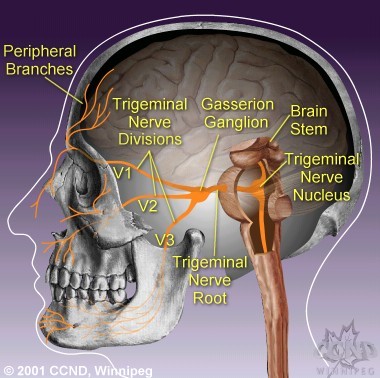 Pain is a very complex sense, because it has such a huge emotional component to it. If you're afraid of the pain, it can actually make your pain worse.
We had FCM this week, and it was about health care policy decisions. There were no small groups--we just had a speaker from the Case Business School for the full hour and a half. This same guy has spoken to us before. I think most of my classmates liked his talk, but I have to say that health care policy bores me to tears. It was, well, kind painful to sit through an hour and a half long lecture on it.
In clinic this afternoon, I had a patient who fit in with the whole pain theme perfectly--she has severe, chronic migraine headaches. There wasn't much for me to do about the migraines besides take the history because the patient was already being followed up at the CCF Pain Clinic. But still, we had quite a lengthy discussion about possible triggers, how the headaches affect her quality of life, and so on. I get an occasional headache myself every now and then, but nothing like this poor patient.
I meant to ask my preceptor today if patients who fit the topics we are covering in school are being booked this way on purpose. If not, this has to be the longest string of coincidences I've ever experienced. Or, maybe it's just that symptoms like pain and headaches are so ubiquitous and I haven't been keeping track of how many previous patients I've seen with headaches. Now that I think about it, patient complaints of headaches aren't exactly rare. If you go through the review of systems with a patient and ask them if they have this or that symptom, almost everyone will say yes to headaches. Who doesn't get a headache every now and then?
Pain is a very complex sense, because it has such a huge emotional component to it. If you're afraid of the pain, it can actually make your pain worse.We had FCM this week, and it was about health care policy decisions. There were no small groups--we just had a speaker from the Case Business School for the full hour and a half. This same guy has spoken to us before. I think most of my classmates liked his talk, but I have to say that health care policy bores me to tears. It was, well, kind painful to sit through an hour and a half long lecture on it.
In clinic this afternoon, I had a patient who fit in with the whole pain theme perfectly--she has severe, chronic migraine headaches. There wasn't much for me to do about the migraines besides take the history because the patient was already being followed up at the CCF Pain Clinic. But still, we had quite a lengthy discussion about possible triggers, how the headaches affect her quality of life, and so on. I get an occasional headache myself every now and then, but nothing like this poor patient.
I meant to ask my preceptor today if patients who fit the topics we are covering in school are being booked this way on purpose. If not, this has to be the longest string of coincidences I've ever experienced. Or, maybe it's just that symptoms like pain and headaches are so ubiquitous and I haven't been keeping track of how many previous patients I've seen with headaches. Now that I think about it, patient complaints of headaches aren't exactly rare. If you go through the review of systems with a patient and ask them if they have this or that symptom, almost everyone will say yes to headaches. Who doesn't get a headache every now and then?
Monday, November 05, 2007
Blogger Challenge Update
Yesterday, a very generous reader donated the remaining amount needed to fully fund the Mississippi skeleton project. I received a very nice letter from the teacher of this class, and I would like to post it here so that everyone who contributed to funding this project will know how much this teacher and her students appreciate what you've done for them.
Thank you so much! I cannot wait until school takes in on Monday to tell my students about your wonderful gift to them! They will be thrilled! Words cannot express the gratitude that I feel. The impact of your generosity will continue through the years to come, and I will make certain that my students remember that a stranger out there cared enough about them to make sure they got what they needed for their education. You will never know the boost to their esteem that such thing produces. Again, thank you from the bottom of my heart, and on behalf of my students, bless you!
I would like to again thank ALL of you generous readers who have donated to the CCLCM Student Blogger Challenge. At this point, we have raised a grand total of $494 to help low-income middle school students, and we have fully funded the Mississippi skeleton project. However, the Bronx reading project still needs another $401. If any of you have been thinking about donating but haven't gotten around to it yet, please consider giving a few dollars so that we can get those books to the kids.
Also, I was looking around on Donors Choose some more over the weekend, and there are so many great medicine and science-themed projects that need funding. I wish I could fund them all. If some of you readers are looking to make a tax-deductible contribution to charity before 2007 slips away from us, here are some other projects that caught my eye. The expiration date is the date when Donors Choose will remove that proposal from their website if it has not been fully funded by that point.
Concentrated Science Investigation (CSI) is a proposal to buy a set of forensics kits for inner city middle school children in North Carolina--expires April 27
First Step Lab, Second Step Nursing School is a proposal to buy two balances for use by low-income, pre-nursing high school students in rural Mississipi--expires April 29
Skeleton in the Classroom is a proposal to buy a model skeleton for inner city elementary school children in Texas--expires June 16
1-2-3..Bison To The Rescue! is a proposal to buy CPR kits to train low income high school students to administer CPR in rural Alabama--expires June 24
Inner Space - What a Trip! is a proposal to buy prepared microscope slides for low income middle school children in rural Mississippi--expires June 27
Protons, Neutrons, Electrons - Oh My! is a proposal to buy chemistry models of DNA and atoms for low income middle school children in rural Mississippi--expires June 27
Exploring The Human Body is a proposal to buy a model of the human body for low income elementary and middle school children in inner city Chicago--expires June 29
Inspiring Future (Urban) Doctors and Nurses is a proposal to buy dissecting supplies for inner city high school students in Massachussetts--expires June 30
Thank you so much! I cannot wait until school takes in on Monday to tell my students about your wonderful gift to them! They will be thrilled! Words cannot express the gratitude that I feel. The impact of your generosity will continue through the years to come, and I will make certain that my students remember that a stranger out there cared enough about them to make sure they got what they needed for their education. You will never know the boost to their esteem that such thing produces. Again, thank you from the bottom of my heart, and on behalf of my students, bless you!
I would like to again thank ALL of you generous readers who have donated to the CCLCM Student Blogger Challenge. At this point, we have raised a grand total of $494 to help low-income middle school students, and we have fully funded the Mississippi skeleton project. However, the Bronx reading project still needs another $401. If any of you have been thinking about donating but haven't gotten around to it yet, please consider giving a few dollars so that we can get those books to the kids.
Also, I was looking around on Donors Choose some more over the weekend, and there are so many great medicine and science-themed projects that need funding. I wish I could fund them all. If some of you readers are looking to make a tax-deductible contribution to charity before 2007 slips away from us, here are some other projects that caught my eye. The expiration date is the date when Donors Choose will remove that proposal from their website if it has not been fully funded by that point.
Concentrated Science Investigation (CSI) is a proposal to buy a set of forensics kits for inner city middle school children in North Carolina--expires April 27
First Step Lab, Second Step Nursing School is a proposal to buy two balances for use by low-income, pre-nursing high school students in rural Mississipi--expires April 29
Skeleton in the Classroom is a proposal to buy a model skeleton for inner city elementary school children in Texas--expires June 16
1-2-3..Bison To The Rescue! is a proposal to buy CPR kits to train low income high school students to administer CPR in rural Alabama--expires June 24
Inner Space - What a Trip! is a proposal to buy prepared microscope slides for low income middle school children in rural Mississippi--expires June 27
Protons, Neutrons, Electrons - Oh My! is a proposal to buy chemistry models of DNA and atoms for low income middle school children in rural Mississippi--expires June 27
Exploring The Human Body is a proposal to buy a model of the human body for low income elementary and middle school children in inner city Chicago--expires June 29
Inspiring Future (Urban) Doctors and Nurses is a proposal to buy dissecting supplies for inner city high school students in Massachussetts--expires June 30
Friday, November 02, 2007
Utterly Exhausted
I keep foolishly thinking that things are finally going to slow down at some point, but they never do. This week was the worst yet. I have only managed to get about half of the week's reading done, and I didn't get any reading done for my MS class yesterday at all. Obviously, this is not going to be a fun weekend, and next week is not looking much better, unfortunately.
This morning's seminars were on neuropsychology and gait disorders. The neuropsychologist who did the neuropsych session came last year also. She was showing us the tests that they give to people to see if they have dementia. Even though we had seen all of these tests last year, it was really helpful to see them again. Somehow, I am just getting more out of seeing these things this year. I think it's because now I'm only 95% confused about neuro instead of a complete 100%. The second session was with Dr. Chemali, who gave us a neuro session on sensation last year. He didn't play Celine Dion for us this year, but we reviewed all of the spinal pathways, and again, it seems to all just be making more sense.
Our ARM session today was a follow-up to last week's small group session where we are ostensibly supposed to be learning about how to write grants. It was, to put it kindly, completely useless. Each group was supposed to give a brief presentation about the project they had come up with, and I volunteered myself and one of my none-too-thrilled classmates to present for our group. The presentations went better than I had expected, because they actually did generate some discussion. But all in all, it was still a pointless exercise in terms of its stated purpose to teach us about writing grants. I think I mentioned last week that you would always start working on a grant by reading the literature so that you knew what the problems in that field are, which we didn't do. That's a pretty important step to just skip over! We were just coming up with hypotheses and methods out of thin air, which doesn't really give a very realistic simulation of the grant-writing experience. This exercise really should be made more structured, if not eliminated from the curriculum altogether.
This morning's seminars were on neuropsychology and gait disorders. The neuropsychologist who did the neuropsych session came last year also. She was showing us the tests that they give to people to see if they have dementia. Even though we had seen all of these tests last year, it was really helpful to see them again. Somehow, I am just getting more out of seeing these things this year. I think it's because now I'm only 95% confused about neuro instead of a complete 100%. The second session was with Dr. Chemali, who gave us a neuro session on sensation last year. He didn't play Celine Dion for us this year, but we reviewed all of the spinal pathways, and again, it seems to all just be making more sense.
Our ARM session today was a follow-up to last week's small group session where we are ostensibly supposed to be learning about how to write grants. It was, to put it kindly, completely useless. Each group was supposed to give a brief presentation about the project they had come up with, and I volunteered myself and one of my none-too-thrilled classmates to present for our group. The presentations went better than I had expected, because they actually did generate some discussion. But all in all, it was still a pointless exercise in terms of its stated purpose to teach us about writing grants. I think I mentioned last week that you would always start working on a grant by reading the literature so that you knew what the problems in that field are, which we didn't do. That's a pretty important step to just skip over! We were just coming up with hypotheses and methods out of thin air, which doesn't really give a very realistic simulation of the grant-writing experience. This exercise really should be made more structured, if not eliminated from the curriculum altogether.
Wednesday, October 31, 2007
Neuro Clinical Correlations
Today was another double seminar day. The first one was about the genetics of dementia, and for the second they showed us video clips of patients with various movement disorders. I liked the genetics seminar, which was a case with a sort of surprise conclusion. The other one was ok, but somehow I just couldn't keep focused. Maybe it's just a matter of it being the last hour of class and the room being nice and dark.
In the afternoon, we had two clinical correlations. The first one involved examining a patient with multiple sclerosis in small groups, which was interesting. But I felt sorry for the patient, who seemed to be pretty tired and kept dozing off in between getting various joints and muscles prodded and poked by us. Afterward, we got an hour-long seminar about MS, which wasn't bad, but it was too long. We had several questions for the speaker, and he had clearly not built in time for questions in his talk. So he started getting a little testy with us for asking so many questions, and we wound up arriving at the EMG lab about 20 minutes late.
EMG stands for electromyography, which is a fancy word for testing the electrical conduction in muscles. They asked us to volunteer for some of the tests, and I did one called a QSART where they administered acetylcholine (a neurotransmitter) to my skin and measured how much it made me sweat. This tests the small nerve fibers that are attached to the sweat glands. I am apparently a slow sweater, because we had to wait a few minutes before anything happened. It doesn't make you sweat gallons or anything--they just collected on the order of a nanoliter of sweat, which is 1 x 10^-9 liters. Two of my classmates did the other tests, one to test breathing and one to test pupillary reflexes. That pupillary one was really cool. We could see his eyes on the computer screen, and when the light flashed, his pupils would contract.
Afterward, we went to a second room to do nerve conduction studies. No one wanted to volunteer, so I did those too. First, they put two electrodes on my hand, and when they then applied a current, it made the muscle contract. That test looks to see if my nerve cells have lost their myelin in some segments. (Myelin is the "insulation" that covers your nerve cells.) It's kind of a weird feeling, because each time the tech turned on the current, my thumb would jerk, and I had no control over it whatsoever. It didn't really hurt though until they moved the current up to my elbow and made my whole arm move. That felt a lot like banging my funny bone, and it was not too pleasant. The second test involved sticking a needle into my thumb muscle. That test is to look for loss or degeneration of my nerve cell axons. The needle is really small, so it didn't really hurt, and the tech said my readings were normal for a young adult. What a relief!
In the afternoon, we had two clinical correlations. The first one involved examining a patient with multiple sclerosis in small groups, which was interesting. But I felt sorry for the patient, who seemed to be pretty tired and kept dozing off in between getting various joints and muscles prodded and poked by us. Afterward, we got an hour-long seminar about MS, which wasn't bad, but it was too long. We had several questions for the speaker, and he had clearly not built in time for questions in his talk. So he started getting a little testy with us for asking so many questions, and we wound up arriving at the EMG lab about 20 minutes late.
EMG stands for electromyography, which is a fancy word for testing the electrical conduction in muscles. They asked us to volunteer for some of the tests, and I did one called a QSART where they administered acetylcholine (a neurotransmitter) to my skin and measured how much it made me sweat. This tests the small nerve fibers that are attached to the sweat glands. I am apparently a slow sweater, because we had to wait a few minutes before anything happened. It doesn't make you sweat gallons or anything--they just collected on the order of a nanoliter of sweat, which is 1 x 10^-9 liters. Two of my classmates did the other tests, one to test breathing and one to test pupillary reflexes. That pupillary one was really cool. We could see his eyes on the computer screen, and when the light flashed, his pupils would contract.
Afterward, we went to a second room to do nerve conduction studies. No one wanted to volunteer, so I did those too. First, they put two electrodes on my hand, and when they then applied a current, it made the muscle contract. That test looks to see if my nerve cells have lost their myelin in some segments. (Myelin is the "insulation" that covers your nerve cells.) It's kind of a weird feeling, because each time the tech turned on the current, my thumb would jerk, and I had no control over it whatsoever. It didn't really hurt though until they moved the current up to my elbow and made my whole arm move. That felt a lot like banging my funny bone, and it was not too pleasant. The second test involved sticking a needle into my thumb muscle. That test is to look for loss or degeneration of my nerve cell axons. The needle is really small, so it didn't really hurt, and the tech said my readings were normal for a young adult. What a relief!
Tuesday, October 30, 2007
Officially Accepted to Grad School
So far, this week has been way intense. We are having double seminars every day again, and double reading too. Sigh. But the seminars have continued to be good on the whole. Yesterday we covered neurodegenerative diseases, and today we did inflammation and infection in the central nervous system. We also had a neuroanatomy session instead of FCM, which is both good and bad. It's good because it was more useful and interesting than an FCM seminar would have been, but it's bad because we had to read forty pages of neuroanatomy on top of all the reading for the other two seminars. Double sigh. My PBL learning objective for Wednesday is about the pathophysiology of tremors.
Clinic this afternoon was really busy. I saw five patients instead of the usual four. I don't know if my preceptor's secretary is scheduling certain patients this way on purpose, but it's uncanny how often I see a patient whose condition is related to whatever we're studying in school at the time. We're covering movement disorders like Parkinson's Disease and multiple sclerosis this week, and what do you know, I had an MS patient in clinic today. I did a neuro exam on the patient, not only because I need to practice doing the neuro exam, but also because there were actually some abnormal findings, mainly cerebellar (having to do with walking and balance). This morning, I also practiced doing some of the mini-mental status exam on one of the first years who had said he was worried about his mental faculties. He is not demented, at least as far as I got in testing him. ;-)
Finally, I am proud to say that I have officially been accepted to the Case Western Reserve University School of Graduate Studies. They sent me an official acceptance letter and everything. It's pretty funny actually, especially the second paragraph:
Dear CCLCMer,
Your credentials for admission to graduate study in the MS/MD program offered through the Clinical Research Scholars Program and the Cleveland Clinic Lerner College of Medicine have been reviewed. I am pleased to inform you that you have been retroactively admitted to this program with full standing for the term beginning August 27, 2007.
I regret that it will not be possible to provide you with an assistantship or fellowship. We have many more applicants for such appointments than we can provide, and our inability to offer you financial aid is no reflection on your promise as a graduate student.
I can't really complain about not getting financial aid. First of all, I didn't even know that I could apply for an assistantship, never mind actually applying for one. Second of all, I'm not actually paying for this MS because the grad classes are included in our med school tuition, so it would be pretty funny if the grad school started giving me financial aid too. All in all, I guess I just should be glad the grad school didn't decide that the med school had made a mistake two years ago when the med school admitted me! :-P
Clinic this afternoon was really busy. I saw five patients instead of the usual four. I don't know if my preceptor's secretary is scheduling certain patients this way on purpose, but it's uncanny how often I see a patient whose condition is related to whatever we're studying in school at the time. We're covering movement disorders like Parkinson's Disease and multiple sclerosis this week, and what do you know, I had an MS patient in clinic today. I did a neuro exam on the patient, not only because I need to practice doing the neuro exam, but also because there were actually some abnormal findings, mainly cerebellar (having to do with walking and balance). This morning, I also practiced doing some of the mini-mental status exam on one of the first years who had said he was worried about his mental faculties. He is not demented, at least as far as I got in testing him. ;-)
Finally, I am proud to say that I have officially been accepted to the Case Western Reserve University School of Graduate Studies. They sent me an official acceptance letter and everything. It's pretty funny actually, especially the second paragraph:
Dear CCLCMer,
Your credentials for admission to graduate study in the MS/MD program offered through the Clinical Research Scholars Program and the Cleveland Clinic Lerner College of Medicine have been reviewed. I am pleased to inform you that you have been retroactively admitted to this program with full standing for the term beginning August 27, 2007.
I regret that it will not be possible to provide you with an assistantship or fellowship. We have many more applicants for such appointments than we can provide, and our inability to offer you financial aid is no reflection on your promise as a graduate student.
I can't really complain about not getting financial aid. First of all, I didn't even know that I could apply for an assistantship, never mind actually applying for one. Second of all, I'm not actually paying for this MS because the grad classes are included in our med school tuition, so it would be pretty funny if the grad school started giving me financial aid too. All in all, I guess I just should be glad the grad school didn't decide that the med school had made a mistake two years ago when the med school admitted me! :-P
Friday, October 26, 2007
Already Sick of Step I
I forgot to mention on Wednesday that you should never tangle with a psychiatrist, because they will always get the last word. When Dean Franco was giving one of our coma seminars, I asked her how she could tell if the patient actually wasn't paying attention due to delirium versus for some other reason. She said if they weren't paying attention for any reason, then it was an alteration of consciousness. So I said, "No, I mean, what if you're asking me where I am or the date, and I just don't want to answer your questions?" Much to the amusement of my classmates, she replied, "Then it means you have a personality disorder!"
Yesterday wasn't terribly eventful. I had my MS class in the morning, though it was kind of hard to get up, and I spent the rest of the day working on my learning objective and trying to catch up on some reading.
Today we had a really good PBL session, probably one of the best we've done all block. The learning objectives were good, and the discussion was good. But no one from the administration came today to see us! Our seminars were on brain trauma and brain tumors. They were good too. I can't believe how much more I'm enjoying neuro this year versus last year. I don't know if the seminars are really just that much better, or the pathology is just more interesting, or I'm just feeling more comfortable with the material because of having studied neuro over the summer, or what.
Our ARM session today was, to put it mildly, simply awful. The school has decided to have us do little research projects where we come up with hypotheses and objectives and who knows what else at various points throughout the year, and today was the first one of those sessions. So we met in our PBL groups, and we were supposed to come up with an experiment based on our PBL case from this week. That has to be the most ridiculous way to come up with a research idea that I've ever heard. If you're wanting to come up with a research project and write a grant proposal, you don't start by thinking up methodology and making up a hypothesis! You start by reading the literature in that area so that you even understand what the current issues are in that field! On the bright side, I have a whole week to think of a way to give constructive criticism about this before we fill out the feedback sheet next Friday at the end of PBL. :-P
Dr. Prayson, who is a neuropathologist and also our new Assistant Dean of Students, invited anyone who was interested to go over the the CCF morgue and look at some brain pathology. About ten of us went this afternoon, and it was really awesome. We saw tumors, infarcts, hemorrhages, all kinds of interesting stuff that we had been learning about this week. One of the brains belonged to a young child, which was a little sad though. But overall, I got so much out of it in terms of learning the anatomy and pathology that I asked him about coming in to see an autopsy some time. He said that we were definitely welcome to do that if we wanted, and that some of the upperclassmen had done it in previous years. I don't know when I will have time to go, and it's kind of hard to set up a time anyway because patients don't exactly die and require autopsies on a set schedule. Maybe I can do it this summer after I take Step I.
Speaking of which, we got an email earlier in the week about attending a session this evening by some of the upperclassmen to give us advice on preparing for Step I. It was from 5:15-6:45 today. Although I felt kind of bad because of how nice the third and fourth years were to do this for us, I decided not to go. I was just too tired, and I also have come to realize that I really don't want to hear a single thing more about Step I at this point. It's bad enough that we have to register for it now, in October, when we aren't even taking it for another eight months. (The reason why we have to register now is that the Case UP students take the test four months earlier than we do, at the beginning of March.) But it's making me feel more stressed and anxious to be talking about studying for it now, when I don't have time to study for it and when I haven't learned enough path yet to even make it worth studying for it. I'm planning to start studying in January, and I don't want to think about it any more between now and then. Please, just give me my last two months of USMLE ignorant bliss!
For those of you who are premeds, don't complain about how much the MCAT costs, because the registration fee for Step I will set you back a cool $480, and Step II is even worse. For those of you who are CCLCM first years, start saving up. I didn't realize that we were going to have to register this early, right before the holidays, and I did not budget that $480 for this semester. :-(
Yesterday wasn't terribly eventful. I had my MS class in the morning, though it was kind of hard to get up, and I spent the rest of the day working on my learning objective and trying to catch up on some reading.
Today we had a really good PBL session, probably one of the best we've done all block. The learning objectives were good, and the discussion was good. But no one from the administration came today to see us! Our seminars were on brain trauma and brain tumors. They were good too. I can't believe how much more I'm enjoying neuro this year versus last year. I don't know if the seminars are really just that much better, or the pathology is just more interesting, or I'm just feeling more comfortable with the material because of having studied neuro over the summer, or what.
Our ARM session today was, to put it mildly, simply awful. The school has decided to have us do little research projects where we come up with hypotheses and objectives and who knows what else at various points throughout the year, and today was the first one of those sessions. So we met in our PBL groups, and we were supposed to come up with an experiment based on our PBL case from this week. That has to be the most ridiculous way to come up with a research idea that I've ever heard. If you're wanting to come up with a research project and write a grant proposal, you don't start by thinking up methodology and making up a hypothesis! You start by reading the literature in that area so that you even understand what the current issues are in that field! On the bright side, I have a whole week to think of a way to give constructive criticism about this before we fill out the feedback sheet next Friday at the end of PBL. :-P
Dr. Prayson, who is a neuropathologist and also our new Assistant Dean of Students, invited anyone who was interested to go over the the CCF morgue and look at some brain pathology. About ten of us went this afternoon, and it was really awesome. We saw tumors, infarcts, hemorrhages, all kinds of interesting stuff that we had been learning about this week. One of the brains belonged to a young child, which was a little sad though. But overall, I got so much out of it in terms of learning the anatomy and pathology that I asked him about coming in to see an autopsy some time. He said that we were definitely welcome to do that if we wanted, and that some of the upperclassmen had done it in previous years. I don't know when I will have time to go, and it's kind of hard to set up a time anyway because patients don't exactly die and require autopsies on a set schedule. Maybe I can do it this summer after I take Step I.
Speaking of which, we got an email earlier in the week about attending a session this evening by some of the upperclassmen to give us advice on preparing for Step I. It was from 5:15-6:45 today. Although I felt kind of bad because of how nice the third and fourth years were to do this for us, I decided not to go. I was just too tired, and I also have come to realize that I really don't want to hear a single thing more about Step I at this point. It's bad enough that we have to register for it now, in October, when we aren't even taking it for another eight months. (The reason why we have to register now is that the Case UP students take the test four months earlier than we do, at the beginning of March.) But it's making me feel more stressed and anxious to be talking about studying for it now, when I don't have time to study for it and when I haven't learned enough path yet to even make it worth studying for it. I'm planning to start studying in January, and I don't want to think about it any more between now and then. Please, just give me my last two months of USMLE ignorant bliss!
For those of you who are premeds, don't complain about how much the MCAT costs, because the registration fee for Step I will set you back a cool $480, and Step II is even worse. For those of you who are CCLCM first years, start saving up. I didn't realize that we were going to have to register this early, right before the holidays, and I did not budget that $480 for this semester. :-(
Wednesday, October 24, 2007
Crazy Daze
This week is just absolutely killing me, although today was a pretty good day as far as school goes. Our PBL group was being observed by one of the administration people this morning. I don't know what it is about us being watched, but somehow it does something to the group dynamics and makes us all act even weirder than we usually do. :-P My learning objective for Friday is on reading EEGs. Our seminars this morning were both about coma, and they were really good. I have to say that overall, this year's NMS block is vastly better than last year's was.
In the afternoon, I had my clinical skills course. First, we had to practice interviewing standardized patients about their sexual history. Most of it is pretty straightforward, but some of the examples we had to read were a little ridiculous. For example, there was one where the patient was arthritic, and the doctor asked if the patient could open their legs to have sex. I read that one and thought, there is no way I will ever ask any arthritic patient that question! Do I look like Dr. Kinsey or Dr. Ruth? I came here to be a clinical researcher, not a sex therapist!
The standardized patients were awesome though. The one I had was playing a lesbian with a rash on her groin, and the interview was pretty uneventful. I asked her about her sexual activity, partners, using protection, satisfaction with her sex life, if anyone was hurting her or forcing her to do anything she didn't want to do, etc. Some of my classmates apparently got treated to detailed descriptions of lesbian sex toys, but I didn't really give my actress too much of an opportunity to go into a lot of details. :-P It felt a lot more awkward doing the interview in class than it ever does in clinic. Having an audience of a physician, a shrink, and three of your classmates watching you interview this person on what is probably the most sensitive subject out there is kind of weird, even though it's all pretend. We got through it all right, but no one ever said that being professional all the time is easy. ;-)
Afterward, we had a Clinical Correlation on impaired physicians, which was AWESOME. Several physicians and nurses who were recovering addicts came to speak with us in small groups about their experiences. Most had been alcoholics, but some had been addicted to opioids or other drugs. They answered our questions about how their addiction had affected their professional and personal lives, and we talked about Alcoholics Anonymous as well. Some of these people attend AA or NA (Narcotics Anonymous) meetings every single day, up to four meetings per day. The main things I learned from this were that being isolated from others and feeling like they were "in control" were two of the biggest risk factors for becoming an addict, or relapsing after getting clean. They also mentioned that statistically, odds are that three or four people in my class of 32 will become addicts or have problems with alcohol or other drugs. That really made their stories seem even more pertinent to us.
This evening, I came home and wrote my paper for class tomorrow. It wound up taking about three and a half hours. I don't like writing papers at the last minute, and I am just so happy that I got it done in time, even though I didn't have a chance to do any of my reading for med school this evening. I can't do it now either, because my class is at 7 AM tomorrow. Sigh.
In the afternoon, I had my clinical skills course. First, we had to practice interviewing standardized patients about their sexual history. Most of it is pretty straightforward, but some of the examples we had to read were a little ridiculous. For example, there was one where the patient was arthritic, and the doctor asked if the patient could open their legs to have sex. I read that one and thought, there is no way I will ever ask any arthritic patient that question! Do I look like Dr. Kinsey or Dr. Ruth? I came here to be a clinical researcher, not a sex therapist!
The standardized patients were awesome though. The one I had was playing a lesbian with a rash on her groin, and the interview was pretty uneventful. I asked her about her sexual activity, partners, using protection, satisfaction with her sex life, if anyone was hurting her or forcing her to do anything she didn't want to do, etc. Some of my classmates apparently got treated to detailed descriptions of lesbian sex toys, but I didn't really give my actress too much of an opportunity to go into a lot of details. :-P It felt a lot more awkward doing the interview in class than it ever does in clinic. Having an audience of a physician, a shrink, and three of your classmates watching you interview this person on what is probably the most sensitive subject out there is kind of weird, even though it's all pretend. We got through it all right, but no one ever said that being professional all the time is easy. ;-)
Afterward, we had a Clinical Correlation on impaired physicians, which was AWESOME. Several physicians and nurses who were recovering addicts came to speak with us in small groups about their experiences. Most had been alcoholics, but some had been addicted to opioids or other drugs. They answered our questions about how their addiction had affected their professional and personal lives, and we talked about Alcoholics Anonymous as well. Some of these people attend AA or NA (Narcotics Anonymous) meetings every single day, up to four meetings per day. The main things I learned from this were that being isolated from others and feeling like they were "in control" were two of the biggest risk factors for becoming an addict, or relapsing after getting clean. They also mentioned that statistically, odds are that three or four people in my class of 32 will become addicts or have problems with alcohol or other drugs. That really made their stories seem even more pertinent to us.
This evening, I came home and wrote my paper for class tomorrow. It wound up taking about three and a half hours. I don't like writing papers at the last minute, and I am just so happy that I got it done in time, even though I didn't have a chance to do any of my reading for med school this evening. I can't do it now either, because my class is at 7 AM tomorrow. Sigh.
Tuesday, October 23, 2007
Round Two of Neuro Block
I had a lot of work to catch up on from last week over the weekend, which meant that I spent most of a very beautiful fall weekend indoors reading about addiction. It didn't quite drive me to drink, and maybe there's a future career for me here, because I actually got all of the SAQs right. (The SAQs are those multiple guess questions we have to do each week.) I have never done that before. The less good part is that I didn't really have much chance to do this week's reading, which means I am as much behind so far this week as ever. Plus, I have a paper due for my MS class on Thursday, so it's not going to be an easy week.
Monday we started our new PBL case, and the patient is in a coma. That is our theme for this week in general. The neuro faculty have been doubling up on the seminars, where we have two one-hour seminars instead of one two-hour seminar each day. The bad thing about that is that they're also assigning us double the reading in a lot of cases. The seminars have been very good though. Yesterday's were on the anatomy and pathology of stroke. The other good thing is that the readings overlap in topic quite a bit, so I am not totally lost in class even though I've been coming in having only finished half of the assigned reading for each seminar.
Today we had a neuroanatomy session. Like last time, they divided us into two groups. One part reviewed the vasculature and ventricles of the brain using models and preserved brains, and the other was a series of questions and cases. The FCM session afterward was about surrogate decision making, which we had already talked about once last year. It wasn't the greatest FCM session, but it wasn't absolutely horrible either.
I had clinic this afternoon, and it wound up being a busy day. The most interesting patient I saw was a guy who was in for a follow-up for hypertension. That didn't sound too exciting initially. But while I was taking his history, he was telling me about his life. It turned out that he was a retired garbage collector. He never went to high school, and after he retired he decided to start taking GED classes. He is old enough to be most of his classmates' father or even grandfather, but he said he was determined to pass the test and earn a high school diploma. I thought that was incredibly impressive and inspiring. When I presented his history afterward, I was amazed to learn that my preceptor, who has cared for this man for several years, never knew that he only had an eighth grade education or that he was working on earning a GED. My preceptor commented that it was common for doctors to just hand printed instructions to patients without ever considering that some patients might not be able to read them. This just proves the point that not obtaining a patient's education level and occupation as part of the history really can affect the doctor's ability to provide the best possible care for that patient.
Monday we started our new PBL case, and the patient is in a coma. That is our theme for this week in general. The neuro faculty have been doubling up on the seminars, where we have two one-hour seminars instead of one two-hour seminar each day. The bad thing about that is that they're also assigning us double the reading in a lot of cases. The seminars have been very good though. Yesterday's were on the anatomy and pathology of stroke. The other good thing is that the readings overlap in topic quite a bit, so I am not totally lost in class even though I've been coming in having only finished half of the assigned reading for each seminar.
Today we had a neuroanatomy session. Like last time, they divided us into two groups. One part reviewed the vasculature and ventricles of the brain using models and preserved brains, and the other was a series of questions and cases. The FCM session afterward was about surrogate decision making, which we had already talked about once last year. It wasn't the greatest FCM session, but it wasn't absolutely horrible either.
I had clinic this afternoon, and it wound up being a busy day. The most interesting patient I saw was a guy who was in for a follow-up for hypertension. That didn't sound too exciting initially. But while I was taking his history, he was telling me about his life. It turned out that he was a retired garbage collector. He never went to high school, and after he retired he decided to start taking GED classes. He is old enough to be most of his classmates' father or even grandfather, but he said he was determined to pass the test and earn a high school diploma. I thought that was incredibly impressive and inspiring. When I presented his history afterward, I was amazed to learn that my preceptor, who has cared for this man for several years, never knew that he only had an eighth grade education or that he was working on earning a GED. My preceptor commented that it was common for doctors to just hand printed instructions to patients without ever considering that some patients might not be able to read them. This just proves the point that not obtaining a patient's education level and occupation as part of the history really can affect the doctor's ability to provide the best possible care for that patient.
Friday, October 19, 2007
Back to School
I got home last night from my conference. It was really good, but also really exhausting. I have come to the realization that it is not very much fun to go to a conference as a second year medical student in the middle of an organ system block. The thing is, the psych profs are not giving me any extensions to turn my work in late or anything, so I had to spend several hours every morning and evening doing my reading and homework for school while all of the residents and fellows were going out having fun and sightseeing. I did manage to do a bit of sightseeing myself, but I definitely didn't have anywhere near as much fun as everyone else did. On the funny side, my PI commented to me that he was glad I came because I probably learned more at the meeting than I would have learned if I had stayed in Cleveland. I said I knew that I had definitely learned more than I would have otherwise, because I still had to do all of the assignments for school anyway, PLUS I attended a bunch of talks at the meeting. :-P
This morning we had PBL. I had been reading the case from the conference and had emailed some ideas and articles to the other members of my group, so I had a clue about what was going on even though I missed Monday and Wednesday. We have decided to be more organized and start having someone be the official board scribe each week. We also agreed that we would go back to doing formal learning objectives from now on.
The seminar today was about personality disorders. It's really funny, but as I was reading about the personality disorders yesterday and listening to the seminar today, I couldn't help but think about all of the people I have met in my life who would fit into one or another personality disorder category. I think probably everyone does this, but it was funny how many people I could say to myself, "hmm, yeah, he IS kind of borderline personality with features of anti-social personality." Yesterday on the plane, this surfer dude was sitting next to me. He saw the article I was reading about personality disorders for today's class and said that probably several of the categories would apply to him. I told him not to worry, substance abuse wasn't a personality disorder. He just kind of looked at me, so then I had to explain about the DSM axes and that personality disorders were a completely different category than being a pothead. Once he understood that he doesn't have a personality disorder (Axis II) because substance abuse is lumped in Axis I with things like psychotic disorders and dementia, he said, "oh, good, I'm really glad I'm not crazy." It made for a rather interesting conversation until he finally passed out after downing his third or fourth gin and tonic.
Our ARM seminar today was kind of boring, and I had a hard time focusing and paying attention the whole time. It was supposed to be about addiction, but instead it was about how some variant of the GABA ion channel seems to cause epilepsy in rats who were irradiated in the womb. Besides the fact that it's kind of cruel to irradiate pregnant rats, I'm not sure how well this rat model even mimics the human disease. The speaker did do studies on human tissue from epileptic patients as well, but he used "non-epileptic" tissue from these same patients as his controls. I wonder if non-epileptic tissue from epileptic patients is actually equivalent to normal brain tissue from non-epileptic patients? It's not like you could take some brain tissue out of a normal person and find out!
This morning we had PBL. I had been reading the case from the conference and had emailed some ideas and articles to the other members of my group, so I had a clue about what was going on even though I missed Monday and Wednesday. We have decided to be more organized and start having someone be the official board scribe each week. We also agreed that we would go back to doing formal learning objectives from now on.
The seminar today was about personality disorders. It's really funny, but as I was reading about the personality disorders yesterday and listening to the seminar today, I couldn't help but think about all of the people I have met in my life who would fit into one or another personality disorder category. I think probably everyone does this, but it was funny how many people I could say to myself, "hmm, yeah, he IS kind of borderline personality with features of anti-social personality." Yesterday on the plane, this surfer dude was sitting next to me. He saw the article I was reading about personality disorders for today's class and said that probably several of the categories would apply to him. I told him not to worry, substance abuse wasn't a personality disorder. He just kind of looked at me, so then I had to explain about the DSM axes and that personality disorders were a completely different category than being a pothead. Once he understood that he doesn't have a personality disorder (Axis II) because substance abuse is lumped in Axis I with things like psychotic disorders and dementia, he said, "oh, good, I'm really glad I'm not crazy." It made for a rather interesting conversation until he finally passed out after downing his third or fourth gin and tonic.
Our ARM seminar today was kind of boring, and I had a hard time focusing and paying attention the whole time. It was supposed to be about addiction, but instead it was about how some variant of the GABA ion channel seems to cause epilepsy in rats who were irradiated in the womb. Besides the fact that it's kind of cruel to irradiate pregnant rats, I'm not sure how well this rat model even mimics the human disease. The speaker did do studies on human tissue from epileptic patients as well, but he used "non-epileptic" tissue from these same patients as his controls. I wonder if non-epileptic tissue from epileptic patients is actually equivalent to normal brain tissue from non-epileptic patients? It's not like you could take some brain tissue out of a normal person and find out!
Friday, October 12, 2007
End of a Hectic Week
I'm leaving for my conference tomorrow! I just finished packing my suitcase, including my suit, which I haven't worn since I was interviewing for medical school two years ago. :-P The entire week has just been so crazy because I had to do this week's school work, get prepared for the conference, and collect up next week's assignments to take with me.
One of next week's assignments is for us to attend an Alcoholics Anonymous (AA) meeting. I went to one at a church near CCF after my MS class yesterday morning with two of my classmates. It was a very good experience, much better than I could have possibly anticipated. We met some regulars who have been coming to AA meetings for several decades. Others were first-time attendees like we were. We told the AA members that we are medical students at the Clinic, we are studying addiction and alcoholism in school, and we want to learn more about how to help our alcoholic patients beat their addiction. I wasn't sure how the regulars would feel about us coming, but they seemed happy to have us there. Several of them even came up to us afterward and talked to us more about their lives, and they invited us to come back again for another meeting whenever we wanted.
Yesterday was just a whirlwind. After the AA meeting, I got my PBL evals finished since they were due today, and I finished logging in all of my patients from Wednesday's peds clinic. It turns out that I saw EIGHT patients. No wonder I was so exhausted--that's twice as many as I see on a normal clinic day in IM! I also prepared my PBL learning objective, which was on adolescent depression.
Our seminar this morning was about sleep, and within a few minutes after it began, I was very tempted to go to sleep. Good thing that 3-57 (the library room where we have our classes) is so cold, or I really might have fallen asleep. The ARM (almost called it POD again!) talk today was kind of boring too. It was about preventing the blood vessels over the brain from spasming and leading to stroke in patients who have just had an aneurysm in the brain. That is an interesting topic, but for some reason the session turned into a discussion between the speaker and the professor in charge of the seminar series. Last year, the prof in charge hardly ever spoke, because the sessions are supposed to be for the students to interact with the faculty, not for the faculty to interact with each other. Not very cool.
There was a neuro histology review session this afternoon. But it was optional, so I opted not to go. Neuro histology wasn't so interesting the first time around that I wanted to go through it again, and I had enough other stuff to do.
I want to take the time to thank those of you who have donated to my Blogger Challenge this past week. So far we have raised $83 toward our goal of $951 to buy a skeleton model and books for underprivileged middle school children. If any of you other readers would like to find out more about my Blogger Challenge or help out, please click here.
One of next week's assignments is for us to attend an Alcoholics Anonymous (AA) meeting. I went to one at a church near CCF after my MS class yesterday morning with two of my classmates. It was a very good experience, much better than I could have possibly anticipated. We met some regulars who have been coming to AA meetings for several decades. Others were first-time attendees like we were. We told the AA members that we are medical students at the Clinic, we are studying addiction and alcoholism in school, and we want to learn more about how to help our alcoholic patients beat their addiction. I wasn't sure how the regulars would feel about us coming, but they seemed happy to have us there. Several of them even came up to us afterward and talked to us more about their lives, and they invited us to come back again for another meeting whenever we wanted.
Yesterday was just a whirlwind. After the AA meeting, I got my PBL evals finished since they were due today, and I finished logging in all of my patients from Wednesday's peds clinic. It turns out that I saw EIGHT patients. No wonder I was so exhausted--that's twice as many as I see on a normal clinic day in IM! I also prepared my PBL learning objective, which was on adolescent depression.
Our seminar this morning was about sleep, and within a few minutes after it began, I was very tempted to go to sleep. Good thing that 3-57 (the library room where we have our classes) is so cold, or I really might have fallen asleep. The ARM (almost called it POD again!) talk today was kind of boring too. It was about preventing the blood vessels over the brain from spasming and leading to stroke in patients who have just had an aneurysm in the brain. That is an interesting topic, but for some reason the session turned into a discussion between the speaker and the professor in charge of the seminar series. Last year, the prof in charge hardly ever spoke, because the sessions are supposed to be for the students to interact with the faculty, not for the faculty to interact with each other. Not very cool.
There was a neuro histology review session this afternoon. But it was optional, so I opted not to go. Neuro histology wasn't so interesting the first time around that I wanted to go through it again, and I had enough other stuff to do.
I want to take the time to thank those of you who have donated to my Blogger Challenge this past week. So far we have raised $83 toward our goal of $951 to buy a skeleton model and books for underprivileged middle school children. If any of you other readers would like to find out more about my Blogger Challenge or help out, please click here.
Wednesday, October 10, 2007
Adolescent Medicine
We had PBL and a seminar on bipolar disorders this morning. The seminar wound up being pretty good, even though the speaker basically didn't cover anticonvulsant drugs at all like he was supposed to do.
In the afternoon, I had peds clinic. I was working with an adolescent medicine specialist. I went in there thinking, "Oh, great, yet another exciting afternoon of well child visits." I figured maybe if I was lucky there would be a few sore throats or earaches. But this clinic was awesome, probably the best clinic day I've ever had. My patients were all teens, and most of them had eating disorders. One was also hearing voices. They were a lot like the kid we've been reading about in this week's PBL case. I know everyone has their share of teenage angst, but not like this. These patients really need help. It was incredibly interesting and also very sad to hear their stories and how much they suffer with body image issues and other problems. I definitely identified with several of them. One patient in particular wanted to go to medical school and even knew all about CCLCM.
I was utterly exhausted by the end of the afternoon. I think today was a lot more emotional for me since I was seeing teens. It was really intense and fast-paced and just an all-around great experience. I am doing my next peds clinic with this same doctor. I'm really not all that interested in going into peds. But if I did do peds, I'd definitely do adolescent medicine!
In the afternoon, I had peds clinic. I was working with an adolescent medicine specialist. I went in there thinking, "Oh, great, yet another exciting afternoon of well child visits." I figured maybe if I was lucky there would be a few sore throats or earaches. But this clinic was awesome, probably the best clinic day I've ever had. My patients were all teens, and most of them had eating disorders. One was also hearing voices. They were a lot like the kid we've been reading about in this week's PBL case. I know everyone has their share of teenage angst, but not like this. These patients really need help. It was incredibly interesting and also very sad to hear their stories and how much they suffer with body image issues and other problems. I definitely identified with several of them. One patient in particular wanted to go to medical school and even knew all about CCLCM.
I was utterly exhausted by the end of the afternoon. I think today was a lot more emotional for me since I was seeing teens. It was really intense and fast-paced and just an all-around great experience. I am doing my next peds clinic with this same doctor. I'm really not all that interested in going into peds. But if I did do peds, I'd definitely do adolescent medicine!
Tuesday, October 09, 2007
Classes and Clinic
Our PBL case this week is pretty interesting, particularly because it keeps getting more complicated and taking unexpected turns. Also, we are supposed to be meeting a patient who has the disease the patient in the PBL case has after Friday's session. Yesterday's seminar was given jointly by a psychiatrist and a psychologist. It was ok, but they could have made it more detailed. I don't know if it's just me, but sometimes it seems like the psych people spend an awful lot of time justifying their field and the work they do. The only other interesting thing that happened yesterday is that I submitted my poster to the CCF art department for printing after class. It will be ready for Friday.
This morning, we had an anatomy session covering neuropsych. The first half went over pictures from our book, and we were asked to locate structures on drawings and brain models for the second half. I only got about a third of the reading done in time for today's session because for some reason, the assignment didn't get put up on the portal until yesterday afternoon. I really hate when they give us the assignments last minute like that. I had actually been more or less keeping up with the reading so far this block until today. :-P
The FCM session was about professionalism, and my small group had a pretty interesting discussion about what to do with patients you just don't like, or patients who you feel you really can't help. The large group talk was all about the life of William Osler, and I should have just skipped it.
My clinic preceptor's secretary forgot to email me to let me know that my preceptor wouldn't be in clinic today. So when I showed up clueless, one of the nurses told me I could just go home. But I didn't want to skip clinic this week since I won't be doing any clinic next week and we are only allowed to miss three or four sessions all year. (I want to wait and miss them in May when I am studying for the boards, not in October!)
I wound up working with a resident and his preceptor instead. We saw three patients. One had a sexually transmitted disease, and oh boy, I'm glad that I am not the one who has to break the news to someone that their spouse was probably fooling around on them. Another one had a rheumatological condition, so that was good timing after last week. The resident and I did a neurological and musculoskeletal exam on the patient. We wound up spending a lot of time in the room with that patient, but it was a good learning experience, and I think we really made the patient feel a lot better. Sometimes just having a name for whatever is wrong with you makes it easier for you to bear having a disease, and that was definitely true in this patient's case.
This morning, we had an anatomy session covering neuropsych. The first half went over pictures from our book, and we were asked to locate structures on drawings and brain models for the second half. I only got about a third of the reading done in time for today's session because for some reason, the assignment didn't get put up on the portal until yesterday afternoon. I really hate when they give us the assignments last minute like that. I had actually been more or less keeping up with the reading so far this block until today. :-P
The FCM session was about professionalism, and my small group had a pretty interesting discussion about what to do with patients you just don't like, or patients who you feel you really can't help. The large group talk was all about the life of William Osler, and I should have just skipped it.
My clinic preceptor's secretary forgot to email me to let me know that my preceptor wouldn't be in clinic today. So when I showed up clueless, one of the nurses told me I could just go home. But I didn't want to skip clinic this week since I won't be doing any clinic next week and we are only allowed to miss three or four sessions all year. (I want to wait and miss them in May when I am studying for the boards, not in October!)
I wound up working with a resident and his preceptor instead. We saw three patients. One had a sexually transmitted disease, and oh boy, I'm glad that I am not the one who has to break the news to someone that their spouse was probably fooling around on them. Another one had a rheumatological condition, so that was good timing after last week. The resident and I did a neurological and musculoskeletal exam on the patient. We wound up spending a lot of time in the room with that patient, but it was a good learning experience, and I think we really made the patient feel a lot better. Sometimes just having a name for whatever is wrong with you makes it easier for you to bear having a disease, and that was definitely true in this patient's case.
Saturday, October 06, 2007
Please Support My Blogger Challenge!
This month, Blogger is partnering with DonorsChoose and asking blog authors to sponsor challenges to raise money for schools. Teachers at schools around the country are able to submit proposals, which are then verified and posted by the DonorsChoose staff. I would like to support two projects that are particularly meaningful to me as a medical student going to a school in an underserved area.
The first project is proposed by a teacher in the South Bronx. She is trying to raise money to buy books for her inner city middle school students to help inspire them to do something big with their lives. The book, which is based on a true story, is called "We Beat the Street." It describes how three boys went from being underprivileged teens to practicing physicians. Even today, there is a shortage of physicians working with minority and low-income populations. Therefore, I am asking my blog readers to please help inspire this teacher's students to think about medicine as a career goal. The total amount of money needed to buy books for all of the students is $536.
The second project is proposed by a science teacher in rural Mississippi. She would like to buy a skeleton model to teach her low income middle school students about human anatomy. She has almost no supplies to use to teach science to her students. I don't know if she will be able to spark an interest in any of them to become future physicians, but I'd like her to at least have the chance to try. She needs $421 to buy the skeleton model.
Thanks so much to those of you who are able to contribute. Even if you can only give a few dollars, every little bit will help. Please click here or on the icon below if you would like to donate to either project in this challenge. To see how much progress has been made toward reaching the total challenge goal of $896 to fund both projects, you can also check out the thermometer in the side bar.

The first project is proposed by a teacher in the South Bronx. She is trying to raise money to buy books for her inner city middle school students to help inspire them to do something big with their lives. The book, which is based on a true story, is called "We Beat the Street." It describes how three boys went from being underprivileged teens to practicing physicians. Even today, there is a shortage of physicians working with minority and low-income populations. Therefore, I am asking my blog readers to please help inspire this teacher's students to think about medicine as a career goal. The total amount of money needed to buy books for all of the students is $536.
The second project is proposed by a science teacher in rural Mississippi. She would like to buy a skeleton model to teach her low income middle school students about human anatomy. She has almost no supplies to use to teach science to her students. I don't know if she will be able to spark an interest in any of them to become future physicians, but I'd like her to at least have the chance to try. She needs $421 to buy the skeleton model.
Thanks so much to those of you who are able to contribute. Even if you can only give a few dollars, every little bit will help. Please click here or on the icon below if you would like to donate to either project in this challenge. To see how much progress has been made toward reaching the total challenge goal of $896 to fund both projects, you can also check out the thermometer in the side bar.
Friday, October 05, 2007
MS Class, Working on My Poster, Finishing Bones, and CCLCM Book Club
Yesterday's clinical trials class was again a review of stuff we had already learned over the summer and last semester. I'm not complaining though--at least one thing in my life is easy! I spent yesterday afternoon working on my poster, and unfortunately my preceptor is making me change things all around yet again. So I'll be doing that this weekend. Thankfully this will have to be the last round of revisions, because I have to turn it in to be printed on Monday.
This morning after PBL, we had two pharm seminars on treatments for rheumatological diseases. To say that the first seminar was poor is about as generous and kind as I can possibly be about it. Maybe that seminar leader was asked at the last minute to replace whoever was supposed to be giving the seminar, because I can't think of any other reason why someone would be that unprepared. The second seminar leader was considerably better. Our POD (oops, I mean ARM) talk today was a basic science one about several proteins involved in the vasculitis immune response. I was initially feeling wary of an entire hour-long talk that was chock-full of pictures of gels and immunoprecipitations, but it actually turned out to be pretty interesting. The speaker had given one of the POD seminars last year too, and this one was completely different.
In the evening, I went to the very first meeting of the new CCLCM Book Club. We had read "Better" by Atul Gawande. I was feeling really tired and cranky, and I almost didn't go. But in the end, I'm glad that I did go, because it was a lot of fun. One of the things that I liked best about it is that we had a mix of first, second, and third years. I had never thought about this, but having people from different classes meet to discuss ethical issues is a really great way to get a lot of different perspectives. I don't think it would work so well for PBL, but it might be useful to have some mixed-class FCM small group discussions.
This morning after PBL, we had two pharm seminars on treatments for rheumatological diseases. To say that the first seminar was poor is about as generous and kind as I can possibly be about it. Maybe that seminar leader was asked at the last minute to replace whoever was supposed to be giving the seminar, because I can't think of any other reason why someone would be that unprepared. The second seminar leader was considerably better. Our POD (oops, I mean ARM) talk today was a basic science one about several proteins involved in the vasculitis immune response. I was initially feeling wary of an entire hour-long talk that was chock-full of pictures of gels and immunoprecipitations, but it actually turned out to be pretty interesting. The speaker had given one of the POD seminars last year too, and this one was completely different.
In the evening, I went to the very first meeting of the new CCLCM Book Club. We had read "Better" by Atul Gawande. I was feeling really tired and cranky, and I almost didn't go. But in the end, I'm glad that I did go, because it was a lot of fun. One of the things that I liked best about it is that we had a mix of first, second, and third years. I had never thought about this, but having people from different classes meet to discuss ethical issues is a really great way to get a lot of different perspectives. I don't think it would work so well for PBL, but it might be useful to have some mixed-class FCM small group discussions.
Wednesday, October 03, 2007
PBL, Seminar, Physical Diagnosis, and Clinical Correlation
Today was a really long day. I had PBL first in the morning, and we just did not have it together as a group today. The seminar afterward was about vasculitis. I hadn't done any of the textbook reading since it was already pretty late by the time I finally got into my apartment last night. But I still thought the seminar was pretty good. It was about vasculitides, which are inflammatory diseases of blood vessels.
In the afternoon, our physical diagnosis session covered the eye exam. My group had a really great preceptor. We got to use the machine to look at one another's retinas. I forget what it's called, but it's that thing where you rest your forehead against a pad and the optometrist is on the other side moving the lenses around. ("Is it better this way--click--or like this?") I was the first "patient," and the preceptor told all of my classmates to try to see the number on my contact lens. It turns out that they could, and I don't think I've ever had such an intensive eye exam by so many people in a row in my entire life!
After that, we spent two hours meeting with patients who have rheumatological diseases for our Clinical Correlation. (Rheumatological diseases are inflammatory diseases of the muscles and joints.) I wish we would have been given some background about the patients before we went into the rooms, because every single meeting started out with the patient asking us what we wanted to know. To which I always replied, "Um, everything. I don't know a thing about you or what you have." The takeaway points I got from this are that rheumatological treatments are tremendously expensive (most of the patients mentioned this) and that more research needs to be done on how to treat rheumatological diseases (several patients expressed the hope that we would become rheumatology researchers.)
As far as I know, no one in my class wants to become a rheumatologist. I've heard several of my classmates express strongly that they have no desire to study rheumatology, and I feel the same way. But I have never felt so bad about disliking a medical field as I do about this one. Here were these poor patients, all of whom donated their time to meet with us, and all of whom have suffered greatly from truly awful diseases that made them physically deformed, telling us how they hoped we'd find new cures for rheumatological diseases. And there I was, unable to stop thinking about how I am not such a huge fan of rheumatology, and that I will gladly stop studying it the very first second that I possibly can.
On the bright side, I finally found my keys. I have started wearing them around my neck. Let's just hope I don't misplace my neck along with my keys next time!
In the afternoon, our physical diagnosis session covered the eye exam. My group had a really great preceptor. We got to use the machine to look at one another's retinas. I forget what it's called, but it's that thing where you rest your forehead against a pad and the optometrist is on the other side moving the lenses around. ("Is it better this way--click--or like this?") I was the first "patient," and the preceptor told all of my classmates to try to see the number on my contact lens. It turns out that they could, and I don't think I've ever had such an intensive eye exam by so many people in a row in my entire life!
After that, we spent two hours meeting with patients who have rheumatological diseases for our Clinical Correlation. (Rheumatological diseases are inflammatory diseases of the muscles and joints.) I wish we would have been given some background about the patients before we went into the rooms, because every single meeting started out with the patient asking us what we wanted to know. To which I always replied, "Um, everything. I don't know a thing about you or what you have." The takeaway points I got from this are that rheumatological treatments are tremendously expensive (most of the patients mentioned this) and that more research needs to be done on how to treat rheumatological diseases (several patients expressed the hope that we would become rheumatology researchers.)
As far as I know, no one in my class wants to become a rheumatologist. I've heard several of my classmates express strongly that they have no desire to study rheumatology, and I feel the same way. But I have never felt so bad about disliking a medical field as I do about this one. Here were these poor patients, all of whom donated their time to meet with us, and all of whom have suffered greatly from truly awful diseases that made them physically deformed, telling us how they hoped we'd find new cures for rheumatological diseases. And there I was, unable to stop thinking about how I am not such a huge fan of rheumatology, and that I will gladly stop studying it the very first second that I possibly can.
On the bright side, I finally found my keys. I have started wearing them around my neck. Let's just hope I don't misplace my neck along with my keys next time!
Tuesday, October 02, 2007
Innovations, Seminars, and Clinic
For those of you who are applying to CCLCM, yesterday was our first interview day this year. I can't believe that we are already interviewing for the class of 2013! The time really flies.
The theme this week is inflammatory diseases, and our seminar yesterday was about the immune system. It was ok, not the best we've had. After PBL and seminar, I went over to the Intercontinental Hotel for part of the afternoon. Right now there is an Innovations Conference going on there with an exhibition (lots of free stuff) and discussion panels. This year's conference topic is on innovations in cardiovascular medicine. I am trying to figure out why I didn't go to this thing last year, because they let the CCLCM students register for free, and the talk I saw yesterday was pretty good. Larry King was hosting it, and Steve Nissen was one of the panel members.
This morning, we had a great seminar on arthritis, followed by FCM. There was some confusion about where to go, so our small group didn't do much discussion because we were already half an hour into the period by the time our preceptor found us. That was ok with me, because it gave me more time to work on my poster. The same lawyer from last week was talking to us again, and as soon as FCM was over, I rushed back to the Intercontinental to hear Judah Folkman speak. Folkman is involved in angiogenesis research. Angiogenesis is the process by which new blood vessels grow. This is a big deal for people who study tumors because if you could choke off their blood supply, you could kill them.
Unfortunately, he must have cancelled, because he didn't show up. One of my classmates and I were walking around the exhibition, and the super nice lady at the desk gave us each a computer bag. We were going to head back to Lerner for lunch when another lady invited us to eat at the conference. Students weren't supposed to be allowed to eat at the conference because the meals were only for people who paid, but we decided to go up there since we were told it was ok. In the end, we didn't stay though because it was a sit-down lunch and we both had clinic today.
This week's clinic went much more smoothly than last week's, except that my preceptor sprang a surprise observed physical on me. At one point, I blanked out and couldn't remember how to start examining the cranial nerves. It kind of bums me out that even after a full year of clinic experience, I still feel so awkward and slow with the physical exam. My preceptor was really nice about it though and told me that it will take several years to become comfortable with the full exam. I don't think I really had a very good conception of how difficult learning to examine patients would be. It's not even that you have to learn all of the steps, but also that you need to stay in practice. I find that often it is hard for me to remember exams that I've learned a few months ago. When I have some time, I will have to watch the Swartz video again. Maybe this weekend.
On a not-so-good note, I lost my keys somewhere today. I wound up spending an hour waiting for the custodian to come let me into my building--luckily, I have a spare set of keys. But I hope I can find the originals because my favorite memory stick is on the keychain. It got dark while I was waiting outside, and there I was doing tomorrow's reading by street lamp. I got plenty of weird looks from people passing by--what, doesn't everyone read vasculitis articles by streetlight? All I can say is that I'm really glad this happened in October and not February!
The theme this week is inflammatory diseases, and our seminar yesterday was about the immune system. It was ok, not the best we've had. After PBL and seminar, I went over to the Intercontinental Hotel for part of the afternoon. Right now there is an Innovations Conference going on there with an exhibition (lots of free stuff) and discussion panels. This year's conference topic is on innovations in cardiovascular medicine. I am trying to figure out why I didn't go to this thing last year, because they let the CCLCM students register for free, and the talk I saw yesterday was pretty good. Larry King was hosting it, and Steve Nissen was one of the panel members.
This morning, we had a great seminar on arthritis, followed by FCM. There was some confusion about where to go, so our small group didn't do much discussion because we were already half an hour into the period by the time our preceptor found us. That was ok with me, because it gave me more time to work on my poster. The same lawyer from last week was talking to us again, and as soon as FCM was over, I rushed back to the Intercontinental to hear Judah Folkman speak. Folkman is involved in angiogenesis research. Angiogenesis is the process by which new blood vessels grow. This is a big deal for people who study tumors because if you could choke off their blood supply, you could kill them.
Unfortunately, he must have cancelled, because he didn't show up. One of my classmates and I were walking around the exhibition, and the super nice lady at the desk gave us each a computer bag. We were going to head back to Lerner for lunch when another lady invited us to eat at the conference. Students weren't supposed to be allowed to eat at the conference because the meals were only for people who paid, but we decided to go up there since we were told it was ok. In the end, we didn't stay though because it was a sit-down lunch and we both had clinic today.
This week's clinic went much more smoothly than last week's, except that my preceptor sprang a surprise observed physical on me. At one point, I blanked out and couldn't remember how to start examining the cranial nerves. It kind of bums me out that even after a full year of clinic experience, I still feel so awkward and slow with the physical exam. My preceptor was really nice about it though and told me that it will take several years to become comfortable with the full exam. I don't think I really had a very good conception of how difficult learning to examine patients would be. It's not even that you have to learn all of the steps, but also that you need to stay in practice. I find that often it is hard for me to remember exams that I've learned a few months ago. When I have some time, I will have to watch the Swartz video again. Maybe this weekend.
On a not-so-good note, I lost my keys somewhere today. I wound up spending an hour waiting for the custodian to come let me into my building--luckily, I have a spare set of keys. But I hope I can find the originals because my favorite memory stick is on the keychain. It got dark while I was waiting outside, and there I was doing tomorrow's reading by street lamp. I got plenty of weird looks from people passing by--what, doesn't everyone read vasculitis articles by streetlight? All I can say is that I'm really glad this happened in October and not February!
Friday, September 28, 2007
End of First Week of NMS
Yesterday I had my Clinical Trials class. It was as painful to get up at 5 AM as I expected it to be. But on the bright side, the classes are only two hours now instead of three hours like last semester. Also, a lot of the material we're covering is basically review from my previous three MS classes, and the book seems pretty readable. There are five of us second years taking the class, plus one fourth year and a bunch of residents and fellows. In the afternoon, I went to the lab to get the rest of my data so that I can start preparing my poster. I can't believe I only have two weeks left until I go to the conference. I'm really looking forward to it, except that I will have a ton of make up work to do.
Today we finished our PBL case and then we had a seminar about fractures. I'm just not all that gung-ho about bones. Too many molecules--it's a veritable alphabet soup. The SAQs that we had to do this week were ridiculous in terms of the specific details they were asking for. One of the CAPPs looks like a good one, and the other is kind of way out there. Well, I guess one good one out of two is better than nothing.
POD is now called ARM, which stands for Advanced Research Methods. I can't decide which acronym is sillier. But I had kind of grown to like POD because saying that you're going to the POD sounds like something out of a bad sci-fi movie. Going to the ARM just sounds...gross. Oh, and apparently the administration has come to the same conclusion that I did about having first year grad students take ARM with us. Namely, it is a bad idea because they just started grad school and they haven't had a chance to learn very much yet. Now they will be taking ARM next year as second year grad students along with the second year CCLCM students (the current first years). It makes a lot more sense to have second year grad students working with second year med students.
Anyway, our ARM speaker today was simply awesome. He works at the Museum of Natural History and his whole talk had us absolutely cracking up. It was quite possibly one of the best seminars I have ever attended, kind of an informative lecture and a comedy show all wrapped up into one. You know, when a guy can make a seminar about something as dry as bone mechanics interesting and even entertaining, that is saying a lot. I wish we had it on video. I would actually watch it again if I could.
Today we finished our PBL case and then we had a seminar about fractures. I'm just not all that gung-ho about bones. Too many molecules--it's a veritable alphabet soup. The SAQs that we had to do this week were ridiculous in terms of the specific details they were asking for. One of the CAPPs looks like a good one, and the other is kind of way out there. Well, I guess one good one out of two is better than nothing.
POD is now called ARM, which stands for Advanced Research Methods. I can't decide which acronym is sillier. But I had kind of grown to like POD because saying that you're going to the POD sounds like something out of a bad sci-fi movie. Going to the ARM just sounds...gross. Oh, and apparently the administration has come to the same conclusion that I did about having first year grad students take ARM with us. Namely, it is a bad idea because they just started grad school and they haven't had a chance to learn very much yet. Now they will be taking ARM next year as second year grad students along with the second year CCLCM students (the current first years). It makes a lot more sense to have second year grad students working with second year med students.
Anyway, our ARM speaker today was simply awesome. He works at the Museum of Natural History and his whole talk had us absolutely cracking up. It was quite possibly one of the best seminars I have ever attended, kind of an informative lecture and a comedy show all wrapped up into one. You know, when a guy can make a seminar about something as dry as bone mechanics interesting and even entertaining, that is saying a lot. I wish we had it on video. I would actually watch it again if I could.
Wednesday, September 26, 2007
Second Year Physical Diagnosis
We had a bone path seminar this morning, and it was actually pretty good. I make my judgment based on the fact that I paid attention without having to really force myself for nearly the whole two hours. Usually, my attention span starts lagging a lot sooner....I haven't forgotten some of last year's painful histo sessions yet. :-P
This afternoon I had my first physical diagnosis class. It's done a little differently this year compared to last year. First of all, only half of us have it at a time instead of the whole class. Last year all 32 of us had PD every other Wednesday afternoon, but now only half of us do, and the other 16 go on Tuesdays. Today we had a communications session that was more or less the same as what we did last year. But the physical diagnosis part afterward was really awesome. There were four stations set up in the four PBL rooms. We went in groups of four from room to room every half an hour.
The first room my group went to covered the legs. The standardized patient was this really funny lady who kind of talked back to the doctor while he was demonstrating the exams, so it was fun for us. In the second room, some podiatrists showed us how to examine the foot. Feet are yucky. No thanks. The third room demo was about examining the shoulders and arms. That one was ok, a bit lecturish though. But the fourth room demo was by far the best. This was the one for the spine. The two docs in there were both orthopedic surgeons, and they were pimping us, but it was done in a gentle and fun way. I am not a huge fan of orthopedics in general, but I liked this one spine guy enough that I am thinking about emailing him to see if I can go work with him in his clinic one day. I think I will ask him, but not this semester. There's just too much going on right now, like my 7 AM MS class tomorrow....
This afternoon I had my first physical diagnosis class. It's done a little differently this year compared to last year. First of all, only half of us have it at a time instead of the whole class. Last year all 32 of us had PD every other Wednesday afternoon, but now only half of us do, and the other 16 go on Tuesdays. Today we had a communications session that was more or less the same as what we did last year. But the physical diagnosis part afterward was really awesome. There were four stations set up in the four PBL rooms. We went in groups of four from room to room every half an hour.
The first room my group went to covered the legs. The standardized patient was this really funny lady who kind of talked back to the doctor while he was demonstrating the exams, so it was fun for us. In the second room, some podiatrists showed us how to examine the foot. Feet are yucky. No thanks. The third room demo was about examining the shoulders and arms. That one was ok, a bit lecturish though. But the fourth room demo was by far the best. This was the one for the spine. The two docs in there were both orthopedic surgeons, and they were pimping us, but it was done in a gentle and fun way. I am not a huge fan of orthopedics in general, but I liked this one spine guy enough that I am thinking about emailing him to see if I can go work with him in his clinic one day. I think I will ask him, but not this semester. There's just too much going on right now, like my 7 AM MS class tomorrow....
Tuesday, September 25, 2007
Seminars, FCM, and Clinic
We had two seminars today on the endocrine control of bone metabolism. It was mostly review from last year, but these seminars weren't too bad. Our FCM session afterward was about medical malpractice. We went over a case where a patient sued a doctor over a delayed diagnosis of lung cancer. The doctor possibly did drop the ball a bit. It wasn't an open-and-shut case though, because the patient skipped several appointments, so he majorly contributed to the delay himself. It was based on a real case, and the jury ultimately decided in favor of the physician.
Today was a long day for me because I had clinic. It was a pretty interesting clinic day. The first patient I had was ridiculously rude. When I introduced myself and went to shake his hand, he just left me hanging there and didn't take it. OK....so I took him over to the scale to weigh him, and he ordered me to put down fresh paper towels so that he didn't have to step directly on the scale. OK....then we went into the room, and I was taking his blood pressure after getting his history. He said to me, "Is this your first day in clinic? Because you're obviously not very experienced." At that point, I decided that we were both sufficiently turned off by one another that any further physical exam would be pointless, so I told him that I would get my preceptor for him and left the room.
This is the first time I have ever had a patient behave like this toward me. When I talked to one of the nurses about it, she assured me that the patient was just like that, he would have treated her the exact same way, it wasn't me, and I shouldn't take it personally. I didn't take it too personally actually, but I viscerally disliked this patient to the point that I think it would have been difficult for me to care for him properly if I were his physician. I think that I managed to hide my feelings well enough that he didn't know what a jerk I thought he was. But it definitely got me to start thinking about what physicians should do when they really dislike a patient and the patient seems to dislike them as well.
My next patient was completely the opposite of the first one. She was really friendly and seemed to enjoy talking to me. She was also very nice about letting me examine her. In fact, at the end of her visit, this patient was assuring me that she was going to schedule her next appointment on a Tuesday afternoon so that she could see me again. Well, I may not be able to please everyone, but at least I can please someone!
I was finished seeing all four of my patients by 4:00, so I wrote up a SOAP note and a journal entry. These are two new requirements for clinic this year. SOAP stands for Subjective, Objective, Assessment, Plan. It is the general outline of how physicians write up reports to go in the patients' charts. Subjective is the patient's story. Objective is what I found during my exam. Assessment is what I think is wrong with the patient. Plan is what treatment I am suggesting. We are also expected to list the patients' medications and look up their uses and whether any can interact with one another. It's pretty time-consuming, but I can see that this is going to help me learn my pharm cold by the end of this year. The journal entry is a research question that I come up with from one of the cases I've seen. There are about a dozen different subject areas that we can research and write about. I did mine on behavioral medicine (psych) because I was interested in whether emotional stress could be causing or at least worsening one of my patient's problems. It turns out that it can.
Today was a long day for me because I had clinic. It was a pretty interesting clinic day. The first patient I had was ridiculously rude. When I introduced myself and went to shake his hand, he just left me hanging there and didn't take it. OK....so I took him over to the scale to weigh him, and he ordered me to put down fresh paper towels so that he didn't have to step directly on the scale. OK....then we went into the room, and I was taking his blood pressure after getting his history. He said to me, "Is this your first day in clinic? Because you're obviously not very experienced." At that point, I decided that we were both sufficiently turned off by one another that any further physical exam would be pointless, so I told him that I would get my preceptor for him and left the room.
This is the first time I have ever had a patient behave like this toward me. When I talked to one of the nurses about it, she assured me that the patient was just like that, he would have treated her the exact same way, it wasn't me, and I shouldn't take it personally. I didn't take it too personally actually, but I viscerally disliked this patient to the point that I think it would have been difficult for me to care for him properly if I were his physician. I think that I managed to hide my feelings well enough that he didn't know what a jerk I thought he was. But it definitely got me to start thinking about what physicians should do when they really dislike a patient and the patient seems to dislike them as well.
My next patient was completely the opposite of the first one. She was really friendly and seemed to enjoy talking to me. She was also very nice about letting me examine her. In fact, at the end of her visit, this patient was assuring me that she was going to schedule her next appointment on a Tuesday afternoon so that she could see me again. Well, I may not be able to please everyone, but at least I can please someone!
I was finished seeing all four of my patients by 4:00, so I wrote up a SOAP note and a journal entry. These are two new requirements for clinic this year. SOAP stands for Subjective, Objective, Assessment, Plan. It is the general outline of how physicians write up reports to go in the patients' charts. Subjective is the patient's story. Objective is what I found during my exam. Assessment is what I think is wrong with the patient. Plan is what treatment I am suggesting. We are also expected to list the patients' medications and look up their uses and whether any can interact with one another. It's pretty time-consuming, but I can see that this is going to help me learn my pharm cold by the end of this year. The journal entry is a research question that I come up with from one of the cases I've seen. There are about a dozen different subject areas that we can research and write about. I did mine on behavioral medicine (psych) because I was interested in whether emotional stress could be causing or at least worsening one of my patient's problems. It turns out that it can.
Monday, September 24, 2007
First Day of NMS, Maltz Museum, and Dinner at Mrs. Lerner's House
Today was a very long first day back, and I am going to be sorry I stayed up so late tonight for the rest of this week. But it was a really eye-opening experience and totally worth it.
For all of second year, we have PBL first thing in the morning on Mondays, Wednesdays, and Fridays, followed by seminar afterward. (This is the opposite of our first year schedule.) Tuesdays we have seminar first, then FCM. This works out well for people who have clinic or physical diagnosis on Tuesdays, because we get out at 11:30 that day instead of 12:00 now. Thursdays are still a day off for most people except for those of us who are taking MS classes or have Thursday clinics.
We had a ton of reading for today about bone genetics and collagen. I had printed out all of the articles before break. So I was unpleasantly surprised to come back today to find that one of the seminar leaders had changed all of the readings at some point while we were gone, and no one had bothered to email us to let us know. I talked to him about it. He said that the articles I read were better ones anyway and I don't have to read the new ones, so that was plenty of consolation.
Our PBL case is really confusing and hard to follow. We weren't really sure about the timeline for a lot of the patient's symptoms or visits. My learning objective is about the effect of anticonvulsants on bone, and it's a really interesting topic. I also went to the lab for a while this afternoon to get some more data and talk to my preceptor about making my poster for the conference next month. I didn't get it all done, so I'm going to have to go back Thursday after class and finish the rest.
This evening, I went to the Maltz Museum. I had never even heard of this museum and knew nothing about it until fairly recently. But there is a new exhibit that just opened there called Deadly Medicine. It is about eugenics during the Nazi era. The exhibit is on loan from the United States Holocaust Museum in Washington, D.C. Most people have probably heard of Dr. Mengele and his infamous medical "experiments" on prisoners. But one of the more shocking parts of the exhibit to me was that thousands of German babies were killed for deformities as minor as a cleft palate. The worst part about it is that the physicians, who were highly educated people and who took an oath to do no harm, were among the leaders in the eugenics movement. Not only did they condone the killing of these children, but they were the ones providing the pseudoscientific justification for doing it.
Today was the opening day for the exhibit. Mrs. Lerner was one of the sponsors responsible for bringing it to Cleveland, and all of us who attended the exhibit opening went to her house for dinner afterward. Most of the other guests were not physicians or medical students, but we had some interesting discussions about the exhibit. For any of you readers who are in Cleveland, the exhibit is well worth seeing and will be open here until January 20th. It will then continue touring other cities around the country. I think it goes to Atlanta, GA next.
For all of second year, we have PBL first thing in the morning on Mondays, Wednesdays, and Fridays, followed by seminar afterward. (This is the opposite of our first year schedule.) Tuesdays we have seminar first, then FCM. This works out well for people who have clinic or physical diagnosis on Tuesdays, because we get out at 11:30 that day instead of 12:00 now. Thursdays are still a day off for most people except for those of us who are taking MS classes or have Thursday clinics.
We had a ton of reading for today about bone genetics and collagen. I had printed out all of the articles before break. So I was unpleasantly surprised to come back today to find that one of the seminar leaders had changed all of the readings at some point while we were gone, and no one had bothered to email us to let us know. I talked to him about it. He said that the articles I read were better ones anyway and I don't have to read the new ones, so that was plenty of consolation.
Our PBL case is really confusing and hard to follow. We weren't really sure about the timeline for a lot of the patient's symptoms or visits. My learning objective is about the effect of anticonvulsants on bone, and it's a really interesting topic. I also went to the lab for a while this afternoon to get some more data and talk to my preceptor about making my poster for the conference next month. I didn't get it all done, so I'm going to have to go back Thursday after class and finish the rest.
This evening, I went to the Maltz Museum. I had never even heard of this museum and knew nothing about it until fairly recently. But there is a new exhibit that just opened there called Deadly Medicine. It is about eugenics during the Nazi era. The exhibit is on loan from the United States Holocaust Museum in Washington, D.C. Most people have probably heard of Dr. Mengele and his infamous medical "experiments" on prisoners. But one of the more shocking parts of the exhibit to me was that thousands of German babies were killed for deformities as minor as a cleft palate. The worst part about it is that the physicians, who were highly educated people and who took an oath to do no harm, were among the leaders in the eugenics movement. Not only did they condone the killing of these children, but they were the ones providing the pseudoscientific justification for doing it.
Today was the opening day for the exhibit. Mrs. Lerner was one of the sponsors responsible for bringing it to Cleveland, and all of us who attended the exhibit opening went to her house for dinner afterward. Most of the other guests were not physicians or medical students, but we had some interesting discussions about the exhibit. For any of you readers who are in Cleveland, the exhibit is well worth seeing and will be open here until January 20th. It will then continue touring other cities around the country. I think it goes to Atlanta, GA next.
Wednesday, September 19, 2007
FAQ # 31: What Masters Programs Are Available for CCLCM and Case UP Students?
Here is a more detailed list of masters programs for people who are interested in getting an MD with a masters degree either through the Case UP or CCLCM. In each case, I have posted how many extra classes are required for CCLCM students. I'm not sure how many extra classes UP students have to take for most of these degrees. But it's probably safe to assume that they take at least as many classes as CCLCM students do, if not more. If any of the UP students who are doing an MS read this and can give me more info on how many extra classes you need to do for your MS, I'd be happy to add that.
Biomedical Investigation MD/MS Programs:
1) Clinical Scholars Research Program (CRSP) MS: This is the MS program that I am doing, and it's one of the more popular choice for CCLCM students. It requires three extra classes on top of the regular CCLCM curriculum, plus two semesters of attending seminar for one hour per week. The two tracks are in Clinical Trials or Disease Mechanisms.
2) Biochemistry MS: This program requires three extra courses (nine hours), a seminar course (1 hour), and an exam. There are no tracks.
3) Epidemiology MS: This program appears to require five extra courses (fifteen hours). There are no tracks.
4) Nutrition: This program requires three extra courses (nine hours), a seminar course (1 hour), and an exam. There are no tracks.
5) Pathology: This program requires three extra courses (nine hours), a seminar course (1 hour), and an exam. There are no tracks.
6) Physiology and Biotechnology: This program requires three extra courses (nine hours), a seminar course (1 hour), and an exam. There are no tracks.
Other Masters Programs at CWRU:
1) Masters of Public Health (MPH):This is a very work-intensive masters program that will require ten classes above the regular CCLCM curriculum. It is apparently possible to finish this degree in the five years if you plan carefully and double up on classes during some semesters. Tracks include Adolescent Health, Epidemiology, Health Care Policy and Administration, Health Promotion and Disease Prevention, International Health, Public Health Research, or Urban Health.
2) Bioethics MA: This is another work-intensive masters program. According to the information sheet, UP students will need to take an extra 24 credit hours on top of their normal med school curriculum, which comes out to be around eight classes. This is apparently possible to accomplish within the normal four-year curriculum. CCLCM students are required to take an additional 18 credit hours on top of our curriculum, assuming that their thesis is done on a bioethics topic. If it is not, then an additional six hours (two classes) of elective credit must be taken.
3) Other Programs: I couldn't find any information about these programs besides the contact information for the program directors. But for the sake of completeness, it is also possible to get an MD/MS with the MS in Applied Anatomy or in Biomedical Engineering. In addition, there is an option for an MD/MBA.
Biomedical Investigation MD/MS Programs:
1) Clinical Scholars Research Program (CRSP) MS: This is the MS program that I am doing, and it's one of the more popular choice for CCLCM students. It requires three extra classes on top of the regular CCLCM curriculum, plus two semesters of attending seminar for one hour per week. The two tracks are in Clinical Trials or Disease Mechanisms.
2) Biochemistry MS: This program requires three extra courses (nine hours), a seminar course (1 hour), and an exam. There are no tracks.
3) Epidemiology MS: This program appears to require five extra courses (fifteen hours). There are no tracks.
4) Nutrition: This program requires three extra courses (nine hours), a seminar course (1 hour), and an exam. There are no tracks.
5) Pathology: This program requires three extra courses (nine hours), a seminar course (1 hour), and an exam. There are no tracks.
6) Physiology and Biotechnology: This program requires three extra courses (nine hours), a seminar course (1 hour), and an exam. There are no tracks.
Other Masters Programs at CWRU:
1) Masters of Public Health (MPH):This is a very work-intensive masters program that will require ten classes above the regular CCLCM curriculum. It is apparently possible to finish this degree in the five years if you plan carefully and double up on classes during some semesters. Tracks include Adolescent Health, Epidemiology, Health Care Policy and Administration, Health Promotion and Disease Prevention, International Health, Public Health Research, or Urban Health.
2) Bioethics MA: This is another work-intensive masters program. According to the information sheet, UP students will need to take an extra 24 credit hours on top of their normal med school curriculum, which comes out to be around eight classes. This is apparently possible to accomplish within the normal four-year curriculum. CCLCM students are required to take an additional 18 credit hours on top of our curriculum, assuming that their thesis is done on a bioethics topic. If it is not, then an additional six hours (two classes) of elective credit must be taken.
3) Other Programs: I couldn't find any information about these programs besides the contact information for the program directors. But for the sake of completeness, it is also possible to get an MD/MS with the MS in Applied Anatomy or in Biomedical Engineering. In addition, there is an option for an MD/MBA.
Friday, September 14, 2007
Heart Center Tour and Class Stuff
Thursday I went to take a tour of the new CCF heart center. It's going to be absolutely incredible: ten stories tall, of which eight floors are for patient care. The top floor will have an outdoor patio and banquet area that looks out over downtown Cleveland and Lake Erie. The view is gorgeous. The nineth floor houses all of the emergency generators for the heart center and the new urological building. There are four of them, and they're enormous. The fourth through eighth floors will have patient rooms, the third floor will be the ORs, and the second floor will have the cath labs. It's going to be absolutely state of the art, and the best part of the whole thing is that it should be opening next summer, just in time for my class to begin our rotations.
It turns out that now we will not be getting our epi assignment until after we get back from break. I'm not thrilled about that, but if they give it to us the first week, it's still early enough to get it done and out of the way before things start getting too crazy with NMS. On the bright side, I am done with my second stats assignment, so at least that's something. In addition, the school has finally begun posting our assignments for next block on the portal. So I guess I'll start doing my school reading over break instead so that I can do my epi assignment during the first week of next block.
In general, I am a very organized person. But I can already see that I will have to be even more organized than normal in order to survive these next three months. I guess if I can make it through my second year of med school, most other things I do in my life will seem pretty easy by comparison!
It turns out that now we will not be getting our epi assignment until after we get back from break. I'm not thrilled about that, but if they give it to us the first week, it's still early enough to get it done and out of the way before things start getting too crazy with NMS. On the bright side, I am done with my second stats assignment, so at least that's something. In addition, the school has finally begun posting our assignments for next block on the portal. So I guess I'll start doing my school reading over break instead so that I can do my epi assignment during the first week of next block.
In general, I am a very organized person. But I can already see that I will have to be even more organized than normal in order to survive these next three months. I guess if I can make it through my second year of med school, most other things I do in my life will seem pretty easy by comparison!
Wednesday, September 12, 2007
Finished with Clinical Research Block
Yesterday morning, we had our orientation for the rest of this year. It started at 8 AM with a one hour pathology session. This was followed by about three straight hours of FCM course information. If the goal was to overwhelm us and overload us, I would say that the FCM course directors have succeeded admirably. (In this context, when I say FCM, I'm not just talking about the Tuesday morning class on humanities in medicine that we take. Physical Diagnosis, Communications Skills, and Longitudinal Clinic are technically also included under the broad heading of FCM, although we don't usually refer to them that way.)
I am feeling relatively skeptical about some of the plans that are in store for us this year. For example, we have to tape an interview with a longitudinal clinic patient. This requires us to check out a video camera and operate it successfully on our own, as well as obtain a patient's signed informed consent. I am not good at operating video cameras or any other electronic equipment. I can already forsee spending a few hours wrestling with the stupid camera in my immediate future. To make matters worse, the first years are also apparently being required to do this, and all 64 of us will be competing for the same five video cameras.
In addition, we are supposed to be doing these research hypothesis generation projects four times this year during POD. The interesting part is that they will be having first year grad students from Lerner working with us. Ostensibly, this is supposed to allow us to learn basic science from them and them to learn clinical science from us. The fact that even the least experienced person in my class already has significantly more basic science background than a first-semester grad student strikes me as being a significant flaw in this plan. In addition, the grad students will presumably not be attending our PBL sessions, so I'm not quite sure how they are going to know what we're creating hypotheses about.
The biggest change, of course, is that we will have clinic and clinical skills twice a week now instead of just once. That, at least, is something that I knew was coming. My clinic and clinical skills days will be Tuesdays and Wednesdays. We are also apparently going to continue having FCM (the class) in future years, although we've been assured that it will be done differently now that CCLCM is creating its own FCM curriculum and not trying to coordinate with the Case UP's FCM curriculum. I'm trying to be open-minded about it, because I do believe that the faculty is sincerely trying to improve the class. One of our sessions is apparently going to involve a trip to the art museum. Well, it may not be the best possible use of my time, but at least it should be fun to do. I'm also glad that they are finally going to have us learn to use Epic, which is the Clinic's electronic charting system. There have already been several times within the last year when I wished I was able to use Epic on my own, and we'll definitely need to be able to use it next year when we hit the wards.
In the afternoon yesterday, our class went through the second set of summer research presentations, and the last third of them were today. One thing I forgot to mention is that my summer PSS tutor from last year came to all of my PSS group members' talks. The eight of us from last summer's PSS group were spread out all over the three days, but our tutor still came to see every one of us give our talks and find out how we were doing. This is the kind of thoughtfulness that reminds me about why I chose to come to this school in the first place. It was incredibly nice of her to come listen to talks for three straight days considering that she has basically not seen most of us for an entire year, and she has been working with a new group of first years doing PSS this summer. To my old PSS tutor: if you're reading this, thanks again for being so supportive. :-)
At this point, all I have left to do is to finish my second stats project and do the upcoming epi project. These are both for my MS classes--the people not getting grad credit are done for the block. I am getting close to finishing the stats project, and we're supposed to get the epi one this weekend. It sucks that I'll have to do it over break now, but I don't want to have to worry about it during our NMS block. So I'm going to have to just suck it up.
I am feeling relatively skeptical about some of the plans that are in store for us this year. For example, we have to tape an interview with a longitudinal clinic patient. This requires us to check out a video camera and operate it successfully on our own, as well as obtain a patient's signed informed consent. I am not good at operating video cameras or any other electronic equipment. I can already forsee spending a few hours wrestling with the stupid camera in my immediate future. To make matters worse, the first years are also apparently being required to do this, and all 64 of us will be competing for the same five video cameras.
In addition, we are supposed to be doing these research hypothesis generation projects four times this year during POD. The interesting part is that they will be having first year grad students from Lerner working with us. Ostensibly, this is supposed to allow us to learn basic science from them and them to learn clinical science from us. The fact that even the least experienced person in my class already has significantly more basic science background than a first-semester grad student strikes me as being a significant flaw in this plan. In addition, the grad students will presumably not be attending our PBL sessions, so I'm not quite sure how they are going to know what we're creating hypotheses about.
The biggest change, of course, is that we will have clinic and clinical skills twice a week now instead of just once. That, at least, is something that I knew was coming. My clinic and clinical skills days will be Tuesdays and Wednesdays. We are also apparently going to continue having FCM (the class) in future years, although we've been assured that it will be done differently now that CCLCM is creating its own FCM curriculum and not trying to coordinate with the Case UP's FCM curriculum. I'm trying to be open-minded about it, because I do believe that the faculty is sincerely trying to improve the class. One of our sessions is apparently going to involve a trip to the art museum. Well, it may not be the best possible use of my time, but at least it should be fun to do. I'm also glad that they are finally going to have us learn to use Epic, which is the Clinic's electronic charting system. There have already been several times within the last year when I wished I was able to use Epic on my own, and we'll definitely need to be able to use it next year when we hit the wards.
In the afternoon yesterday, our class went through the second set of summer research presentations, and the last third of them were today. One thing I forgot to mention is that my summer PSS tutor from last year came to all of my PSS group members' talks. The eight of us from last summer's PSS group were spread out all over the three days, but our tutor still came to see every one of us give our talks and find out how we were doing. This is the kind of thoughtfulness that reminds me about why I chose to come to this school in the first place. It was incredibly nice of her to come listen to talks for three straight days considering that she has basically not seen most of us for an entire year, and she has been working with a new group of first years doing PSS this summer. To my old PSS tutor: if you're reading this, thanks again for being so supportive. :-)
At this point, all I have left to do is to finish my second stats project and do the upcoming epi project. These are both for my MS classes--the people not getting grad credit are done for the block. I am getting close to finishing the stats project, and we're supposed to get the epi one this weekend. It sucks that I'll have to do it over break now, but I don't want to have to worry about it during our NMS block. So I'm going to have to just suck it up.
Monday, September 10, 2007
Clinical Research Talks
It was really nice not having class this morning, but I still got up early so that I could spend some time rehearsing my talk a few more times. This is the last week of the block--not that I'm counting or anything! Like last year, we each are giving a ten-minute presentation about our summer research protocol, followed by five minutes of questions from the audience. My talk was today. The other two thirds of my classmates will go tomorrow and Wednesday afternoons.
Now that I've given my presentation, I would be completely done with school for this block except that I still have to write about a hundred evaluations. (I'm exaggerating, but only very slightly!) I also have to finish my second stats project for credit and wrap up a few other small odds and ends. It turns out that we ARE going to be getting an additional epi assignment. I got a solemn promise from the prof to get it to us by this Friday so that I can do it over break. Well, I can't say that working on epi over break was really my plan, but if I can just get it done before we start up with neuro block the week after next, I'll be satisfied.
It looks like we're going to be in for some cooler weather for the rest of this week. Even though it's only September, the lows tomorrow and Wednesday are going to be in the 50s or maybe even the high 40s. I hope this doesn't mean that we are in for a really freezing winter....
Now that I've given my presentation, I would be completely done with school for this block except that I still have to write about a hundred evaluations. (I'm exaggerating, but only very slightly!) I also have to finish my second stats project for credit and wrap up a few other small odds and ends. It turns out that we ARE going to be getting an additional epi assignment. I got a solemn promise from the prof to get it to us by this Friday so that I can do it over break. Well, I can't say that working on epi over break was really my plan, but if I can just get it done before we start up with neuro block the week after next, I'll be satisfied.
It looks like we're going to be in for some cooler weather for the rest of this week. Even though it's only September, the lows tomorrow and Wednesday are going to be in the 50s or maybe even the high 40s. I hope this doesn't mean that we are in for a really freezing winter....
Friday, September 07, 2007
End of Clinical Research Block and More on PD Article
Our research proposals and research talk slides were due today, and we had our last stats group project presentations yesterday, so this has been a crazy and hectic week. I got my proposal turned in yesterday and my slides done this morning--I was on version number five by the time I turned them in to the research office. The funniest part about this whole thing, once I got over feeling annoyed about having to redo my slides yet again, is that my preceptor has made so many corrections to my slides by this point that he is now correcting his own corrections!
We talked about Steve Nissen's controversial meta-analysis of rosiglitazone (Avandia) this morning during journal club. Coverage of his article was all over the news a few months ago, because he found that there was a 43% increase in the relative risk of heart attacks in diabetic people taking Avandia. It was an interesting article in its own right because we had a very good discussion about the strengths and weaknesses of meta-analyses in general. (A meta-analysis takes several articles and pools their results together to come up with an overall set of conclusions.) But of course this one was particularly interesting since Dr. Nissen is a very prominent person and works here at the Clinic.
The second article was interesting also, though not quite as political. In that one, the authors were trying to calculate whether it made sense to screen patients' genogypes before giving them a type of drug called an ACE inhibitor. (ACE inhibitors are used to decrease blood pressure and improve kidney function.) The authors did some calculations and found that it does make sense to screen patients....assuming, of course, that their assumptions were correct. ;-)
There isn't much new information for me to report concerning Wednesday's Plain Dealer article. Yesterday there was an editorial in the PD commenting on their own article from Wednesday. The Clinic also released a statement in response to the PD article:
Cleveland Clinic has had a longstanding, mutually beneficial relationship with Case Western Reserve University to advance research, medical education and other institutional projects. That relationship has not changed and we continue to work collaboratively with the University. Recently, Case announced a new, 50-year, primary affiliation with University Hospitals of Cleveland that strengthened the relationship between those two organizations. At this time, it is unclear how that relationship may impact the Clinic in the future. The Clinic has a number of relationships with colleges and universities across the country and will continue to explore other opportunities as they arise. We cannot comment on specific discussions with other universities. Cleveland Clinic is proud of the Cleveland Clinic Lerner College of Medicine of Case Western Reserve University and is fully committed to excellence in medical education, research and other scientific programs.
We talked about Steve Nissen's controversial meta-analysis of rosiglitazone (Avandia) this morning during journal club. Coverage of his article was all over the news a few months ago, because he found that there was a 43% increase in the relative risk of heart attacks in diabetic people taking Avandia. It was an interesting article in its own right because we had a very good discussion about the strengths and weaknesses of meta-analyses in general. (A meta-analysis takes several articles and pools their results together to come up with an overall set of conclusions.) But of course this one was particularly interesting since Dr. Nissen is a very prominent person and works here at the Clinic.
The second article was interesting also, though not quite as political. In that one, the authors were trying to calculate whether it made sense to screen patients' genogypes before giving them a type of drug called an ACE inhibitor. (ACE inhibitors are used to decrease blood pressure and improve kidney function.) The authors did some calculations and found that it does make sense to screen patients....assuming, of course, that their assumptions were correct. ;-)
There isn't much new information for me to report concerning Wednesday's Plain Dealer article. Yesterday there was an editorial in the PD commenting on their own article from Wednesday. The Clinic also released a statement in response to the PD article:
Cleveland Clinic has had a longstanding, mutually beneficial relationship with Case Western Reserve University to advance research, medical education and other institutional projects. That relationship has not changed and we continue to work collaboratively with the University. Recently, Case announced a new, 50-year, primary affiliation with University Hospitals of Cleveland that strengthened the relationship between those two organizations. At this time, it is unclear how that relationship may impact the Clinic in the future. The Clinic has a number of relationships with colleges and universities across the country and will continue to explore other opportunities as they arise. We cannot comment on specific discussions with other universities. Cleveland Clinic is proud of the Cleveland Clinic Lerner College of Medicine of Case Western Reserve University and is fully committed to excellence in medical education, research and other scientific programs.
Wednesday, September 05, 2007
Finishing Up Research Stuff and Plain Dealer Article
Yesterday wasn't a particularly exciting day except that we got free books from one of the CCF rheumatologists who is a block leader for our upcoming Neuromusculoskeletal (NMS) block. She was telling us how previous students and residents loved this book and had gotten really interested in rheumatology because of it. I'm not sure that I'd go so far as to say that any book will get me all that excited about rheumatology, because NMS was by far my least favorite block last year. But I sure gotta love anyone who gives me free books! I spent the entire afternoon going over my slides with my research preceptor--to make a long story short, I pretty much have to redo them all over again. Although I wasn't thrilled about that, I have to admit that his organization is a lot better than mine was. Presenting clinical research is sure not very much like presenting basic science research.
Today more than made up for the lack of excitement yesterday, however. There was an article in this morning's Cleveland Plain Dealer claiming that CCLCM was going to be switching its affiliation from Case School of Medicine to Columbia. Dean Fishleder met with the CCLCM students this afternoon to discuss the article. Basically he told us that the article's conclusions were premature. It is true that the Clinic is looking at its options with other schools, but a new affiliation with Columbia or any other school is certainly not the done deal that the Plain Dealer made it out to be.
Today more than made up for the lack of excitement yesterday, however. There was an article in this morning's Cleveland Plain Dealer claiming that CCLCM was going to be switching its affiliation from Case School of Medicine to Columbia. Dean Fishleder met with the CCLCM students this afternoon to discuss the article. Basically he told us that the article's conclusions were premature. It is true that the Clinic is looking at its options with other schools, but a new affiliation with Columbia or any other school is certainly not the done deal that the Plain Dealer made it out to be.
Monday, September 03, 2007
Labor Day
This whole weekend has been just gorgeous: sunny, mid-seventies. Unfortunately, I was indoors chained to this laptop for most of it. But this morning I ran the Miles for Smiles 5K, which goes through Cleveland Heights (one of the neighborhoods near the Clinic) and raises money for Operation Smile. I used to run road races a lot in college, but I haven't been doing much running since I started med school. So today I was in the back of the group, just jogging along. There was a man with his elementary school-aged son right in front of me. About half a mile into the race, the boy was worn out and started walking. His dad repeatedly kept trying to make him run and go faster, when it was clear that the boy wasn't in good enough shape to keep up that kind of pace. Finally, the dad gave up and just walked with the boy. I felt really bad watching this, because I didn't feel like I could really intervene or do anything to help, and also because now this boy will probably hate running and will never do it again as soon as he moves out of his father's home.
People put way too much pressure on kids, and on themselves too, during races. That's the downside of running sometimes--runners can be competitive to the point where it's hard to even enjoy the run for what it is. I'm as guilty of this as anyone. When I got to the two mile point, the volunteer standing there told me my time. My initial reaction was to think, "wow, I used to finish the whole 5K in less time than that, and here I'm only 2/3 of the way through!" But I reminded myself that the run was supposed to be FUN, not stressful, and I cruised in very comfortably at the end.
They had a raffle afterward, and I continued my usual streak of winning nothing. I must be the most unlucky person on earth when it comes to raffles. If there were 50 prizes and 51 tickets, I'd be that 51st ticketholder. :-P
People put way too much pressure on kids, and on themselves too, during races. That's the downside of running sometimes--runners can be competitive to the point where it's hard to even enjoy the run for what it is. I'm as guilty of this as anyone. When I got to the two mile point, the volunteer standing there told me my time. My initial reaction was to think, "wow, I used to finish the whole 5K in less time than that, and here I'm only 2/3 of the way through!" But I reminded myself that the run was supposed to be FUN, not stressful, and I cruised in very comfortably at the end.
They had a raffle afterward, and I continued my usual streak of winning nothing. I must be the most unlucky person on earth when it comes to raffles. If there were 50 prizes and 51 tickets, I'd be that 51st ticketholder. :-P
Saturday, September 01, 2007
Journal Club and All Abstracts Submitted
Yesterday we had journal club. It has by far been my favorite class each week for the entire summer. This week's articles were one on whether Americans meet calcium requirements (the authors concluded that we don't) and a second one on whether treating people with prehypertension would help prevent them from progressing to full-blown hypertension (the authors concluded that it does). The first article on calcium requirements was particularly funny because there is no recommended daily allowance (RDA) for calcium. This is because we don't really know how much calcium people actually need. So it's kind of difficult to know whether the problem is really that people don't consume enough calcium, or just that the authors' admittedly arbitrary choice of a threshold was simply too high.
The second article was really interesting. I hadn't appreciated how progressive hypertension is. Normal blood pressure should be 120/80 or less. People who fall in the range above that but below full-blown hypertension, which starts at 140/90, are considered to be prehypertensive. The other sad thing is that most people become hypertensive eventually if they live long enough. So yet again, I am finding out that the key to good health is to stay young.
Yesterday afternoon, I finished my abstract for our school presentations, which will be the week after next, and submitted it. Today I got my abstract done for the conference I'm attending next month and submitted that too. I still have to make up my powerpoint slides for school and a poster for the conference, but things are finally winding down a little. We had a patient yesterday also, but it was another control.
Today is September 1, and a new, controversial CCF policy of refusing to hire smokers is going into effect. I've seen several people decrying it on the internet as discriminatory and overly invasive, so it will be interesting to see how things turn out. At this point, I'm not really sure how I feel about the policy. I can see some validity in the arguments for both sides. Plus, the arguments on both sides have been so extreme that it's hard to know what the actuality will really be like. I suspect the policy won't be as helpful in promoting health as the proponents claim, nor will it be as horrific a violation of privacy as the detractors are warning about.
The second article was really interesting. I hadn't appreciated how progressive hypertension is. Normal blood pressure should be 120/80 or less. People who fall in the range above that but below full-blown hypertension, which starts at 140/90, are considered to be prehypertensive. The other sad thing is that most people become hypertensive eventually if they live long enough. So yet again, I am finding out that the key to good health is to stay young.
Yesterday afternoon, I finished my abstract for our school presentations, which will be the week after next, and submitted it. Today I got my abstract done for the conference I'm attending next month and submitted that too. I still have to make up my powerpoint slides for school and a poster for the conference, but things are finally winding down a little. We had a patient yesterday also, but it was another control.
Today is September 1, and a new, controversial CCF policy of refusing to hire smokers is going into effect. I've seen several people decrying it on the internet as discriminatory and overly invasive, so it will be interesting to see how things turn out. At this point, I'm not really sure how I feel about the policy. I can see some validity in the arguments for both sides. Plus, the arguments on both sides have been so extreme that it's hard to know what the actuality will really be like. I suspect the policy won't be as helpful in promoting health as the proponents claim, nor will it be as horrific a violation of privacy as the detractors are warning about.
Subscribe to:
Posts (Atom)


 Posts
Posts

